
Charities are expected to explain more than what they did.
Trustees, funders, partners and supporters increasingly need to understand what changed as a result.
That distinction matters. Recording that a programme delivered 500 sessions tells you about activity. It does not, by itself, demonstrate whether those sessions achieved the outcomes the programme was created to deliver.
Salesforce can help charities bring programme, service, supporter and outcome information together so that impact reporting is based on reliable operational data rather than an end-of-year exercise involving several spreadsheets.
But the technology should come second.
At Sweet Potato Tec, our Salesforce for Charities & Non-Profits work starts with what the organisation needs to understand and demonstrate. Salesforce can then be designed to capture the evidence needed to answer those questions.
How can Salesforce help a charity measure impact?
Salesforce can help charities measure impact by connecting information about beneficiaries, programmes, services and activities with defined outcomes and reporting requirements. Dashboards and reports can then turn that structured data into evidence for operational teams, trustees and funders. The charity must define meaningful outcomes first. Salesforce enables consistent measurement and reporting, but it does not decide what impact means.
What is the difference between recording activity and measuring impact?
Activity tells you what happened. Impact asks what changed as a result.
This is one of the most important distinctions to make before building an impact-reporting system.
A charity might record:
- how many people used a service
- how many sessions were delivered
- how many volunteers participated
- how many hours were volunteered
- how many people attended an event
- how many grants were distributed
- how many referrals were received.
These are useful measures.
But they mainly describe outputs.
Impact measurement goes further.
Did the service improve an outcome for the people using it?
Did participants achieve the intended progression?
Did the programme address the need it was designed to address?
Did an intervention create a measurable change?
Did that change persist?
The precise questions depend on the charity and the work it delivers.
This is why Salesforce should not be the starting point.
If an organisation begins by asking, “Which fields should we create?”, it risks building a database full of information without first deciding what that information is supposed to prove.
Start with the outcome.
Then determine what evidence needs to be captured to understand it.
Should a charity define its outcomes before configuring Salesforce?
Yes. Outcomes should be defined before the Salesforce data model and reporting structure are finalised.
Otherwise, technology can end up determining the measurement framework instead of supporting it.
Start with questions such as:
What change is this programme intended to create?
Who should experience that change?
What would indicate that the change has happened?
When should it be measured?
Which activities are expected to contribute to it?
What evidence do funders require?
What does the board need to understand?
What information would help frontline teams improve delivery?
Once those questions are clear, the Salesforce requirement becomes easier to define.
For example, the charity may need to record an initial position, services delivered, milestones reached and a later outcome.
Another programme may have a completely different measurement model.
At Sweet Potato Tec, our Salesforce implementation approach begins with business goals, processes, existing systems and data before solution design.
For charities, that means understanding the intended outcome and reporting obligation before deciding how Salesforce should capture the information.
How can Salesforce record beneficiary and service-delivery information?
Salesforce can be configured to maintain structured information about programmes, services, cases, interactions and outcomes where this is appropriate to the charity’s work.
For human-services organisations, that can be particularly important.
Sweet Potato Tec’s Salesforce for Human Services Charities work includes case and service management, case tracking and workflows, notes and interactions, programme-based service delivery and outcome reporting.
That creates the foundation for impact measurement.
Instead of asking teams to reconstruct service activity months later for a report, relevant information can be captured as part of normal delivery.
That does not mean frontline teams should be asked to complete dozens of fields after every interaction.
The system needs to be proportionate.
A useful design question is:
What is the minimum reliable information we need to capture during delivery in order to understand the service and its outcomes later?
That approach is usually more sustainable than collecting everything that might conceivably be useful.
If staff find the process too burdensome, data quality will suffer and the impact reports built from that data will become less trustworthy.
How can charities connect activities with outcomes?
Activities and outcomes need to be represented as related but distinct information.
That allows a charity to understand not only what was delivered, but what happened afterwards.
Imagine a programme providing a series of interventions.
The organisation may want to know:
Who participated?
What support did they receive?
How frequently did they engage?
What outcome was the programme aiming for?
Was that outcome achieved?
When was it assessed?
What evidence supports that assessment?
The exact model will vary enormously between organisations.
For one charity, the outcome might relate to employment, education or independent living.
For another, it may relate to animal welfare, community engagement or another mission-specific result.
Salesforce can provide the structure that connects delivery with those outcome records.
Sweet Potato Tec’s nonprofit proposition specifically includes outcome and impact tracking alongside visibility across programmes and services.
The value is that outcome information does not need to exist in isolation from the operational work that produced it.
That creates a clearer evidence trail.
Why does data quality matter so much for impact reporting?
Impact reporting is only as trustworthy as the data underneath it.
A polished dashboard cannot compensate for inconsistent definitions, missing records or information entered differently by different teams.
Suppose two services both report the number of people they have supported.
One counts every interaction.
The other counts each individual once.
Putting both figures on the same dashboard would create a misleading comparison even if the technology itself worked perfectly.
Data quality therefore starts with common definitions.
What counts as an active participant?
What counts as programme completion?
When is an outcome considered achieved?
How should a person engaging with several services be counted?
What happens when information is incomplete?
Who is responsible for correcting it?
These decisions need to be understood by the people entering and using the information.
Sweet Potato Tec’s Salesforce implementation work includes data quality and governance because reliable reporting depends on reliable underlying information.
The principle is straightforward:
If a charity cannot explain how a figure was produced, it should be cautious about using that figure as evidence of impact.
How can Salesforce dashboards support trustees, funders and operational teams?
Salesforce reporting can provide different audiences with the information they actually need rather than forcing everyone to work from one enormous report.
An operational manager may need to know what is happening now.
Which programmes are reaching capacity?
Where is information incomplete?
Are particular outcomes being achieved?
A trustee may need a higher-level view across programmes and reporting periods.
A funder may require evidence relating specifically to the programme or grant they support.
Leadership may need to understand trends across services.
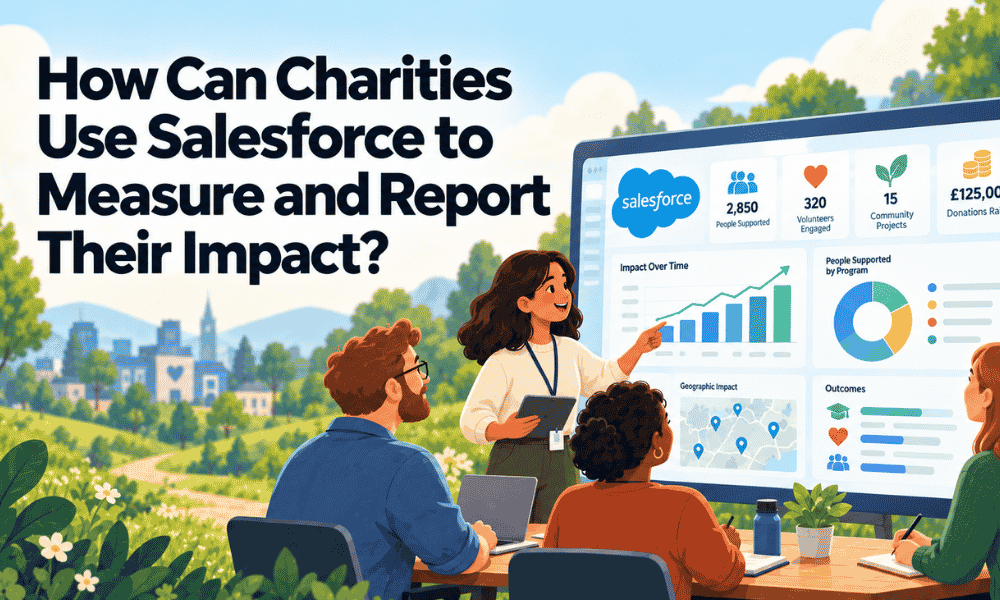
Sweet Potato Tec’s Salesforce for Charities & Non-Profits proposition includes real-time dashboards and reports, outcome and impact tracking, information for funding applications and reviews, and visibility across programmes and services.
Our human-services proposition similarly includes dashboards for leadership and boards and faster funder reporting based on current data.
For organisations with more advanced analytics requirements, Salesforce CRM Analytics can bring Salesforce and external data into a common analytics layer and provide interactive dashboards.
But sophistication should follow need.
A charity does not require advanced analytics simply because it is available.
If a straightforward Salesforce report reliably answers the question, that may be the better solution.
How can Salesforce make funder reporting easier?
Salesforce can make funder reporting easier when the information required for reports is captured consistently during normal operations.
That reduces the need to reconstruct evidence when a reporting deadline arrives.
A grant-funded charity might need to demonstrate:
- how many people were supported
- which services they received
- progress against agreed outcomes
- activity during a particular funding period
- how funding was allocated
- evidence required against grant conditions.
The exact requirements will vary between funders.
The system therefore needs to reflect the reporting obligations attached to the charity’s actual funding arrangements.
Sweet Potato Tec’s nonprofit proposition includes grant tracking and reporting alongside impact reporting, while our human-services work includes grant requirements, outcome tracking and funding visibility across services.
The organisational benefit is continuity.
Rather than asking several teams to produce spreadsheets at the end of the quarter, the relevant data can already be available for review.
That can reduce administrative effort and allow reporting teams to spend more time interpreting the evidence rather than assembling it.
How should charities protect sensitive beneficiary information?
Sensitive information should be protected through deliberate data design, appropriate access controls and clear organisational policies.
A single Salesforce platform does not mean every user should have access to every record or field.
This is particularly important for charities delivering human services.
Information about beneficiaries, cases, safeguarding or personal circumstances may be far more sensitive than ordinary supporter or fundraising information.
Sweet Potato Tec’s Salesforce for Human Services Charities proposition explicitly includes role-based security and access alongside safeguarding-aware processes.
That principle should carry into impact reporting.
A trustee or funder may need aggregate evidence about programme outcomes.
They do not necessarily need access to the underlying personal information used to calculate those figures.
When designing Salesforce, ask:
Who genuinely needs access to this information?
What level of detail do they require?
Can reporting use aggregated information?
Which fields or records require stronger restrictions?
How should sensitive information be retained?
The organisation’s own data-protection, safeguarding and information-governance requirements should determine those decisions.
Salesforce can implement appropriate controls.
It does not replace those organisational responsibilities.
Can fundraising, operational and impact data be reported together?
Yes, where the data model and access arrangements are designed appropriately, Salesforce can connect fundraising, programme, service and impact information.
This can give charities a broader organisational view.
For example, leadership may need to understand which programmes are being funded, what activity those programmes are delivering and what outcomes are being recorded.
A grant team may need visibility of funding requirements alongside programme performance.
Fundraisers may need approved evidence about impact when communicating with supporters.
Trustees may need to understand both financial sustainability and mission delivery.
Sweet Potato Tec’s nonprofit proposition is built around this type of connected operating model, bringing donor and supporter management, fundraising and grants, volunteering, programmes and impact reporting onto Salesforce.
That does not mean every dataset should simply be joined together.
Sensitive beneficiary information still needs appropriate separation and access.
Nor does it mean every possible relationship between funding and outcomes can be treated as direct causation.
The advantage is that teams can work from a more consistent evidence base rather than maintaining completely separate versions of organisational performance.
What can charities learn from replacing spreadsheet-based reporting?
Moving reporting into Salesforce can improve timeliness and consistency, but only when the underlying processes and integrations are addressed as well.
Sweet Potato Tec’s work with the Charity Retail Association provides useful evidence.
Before the project, its website and Salesforce operated in silos, reporting relied on spreadsheets and leadership lacked timely information for decision-making.
Sweet Potato Tec connected Salesforce with the organisation’s website and Eventbrite, introduced automation and created a more integrated environment.
Cross-functional teams subsequently gained access to shared, up-to-date information, while manual tasks and errors were reduced.
This was not specifically an impact-measurement project, so it should not be presented as one.
It does demonstrate something important about reporting:
better dashboards start with better information flows.
If impact information is fragmented across systems and spreadsheets, building another dashboard on top will not solve the underlying problem.
How can charities avoid overcomplicating impact measurement?
Measure what is useful, not everything that Salesforce is capable of storing.
Complex impact frameworks can become difficult for frontline teams to maintain and difficult for leadership to interpret.
Before creating another field, metric or dashboard, ask:
Who will use this information?
What decision will it inform?
Is it required by a funder or regulator?
Does it help us understand whether the programme is working?
Can it be collected reliably?
Is the burden of collecting it proportionate to its value?
If there is no convincing answer, reconsider whether the measure is necessary.
Start with a small number of clearly defined outcomes.
Agree how they will be measured.
Make data capture part of normal operational processes.
Then expand the reporting model when there is a genuine reason to do so.
This is particularly important for charities with stretched teams.
The objective is not to build the most sophisticated measurement system possible.
It is to build one that people will use consistently and that produces evidence the organisation can trust.
What should a charity do before building impact reporting in Salesforce?
Start with the questions the organisation needs to answer.
A practical process might look like this:
1. Define the outcomes
Agree what change each programme or service is intended to create.
2. Identify the audiences
Understand what frontline teams, leadership, trustees, funders and partners need to know.
3. Define the evidence
Determine which information would demonstrate progress towards each outcome.
4. Map current data
Identify what is already captured, where it lives and whether it can be trusted.
5. Agree definitions
Make sure teams use terms and measures consistently.
6. Design the Salesforce structure
Create the appropriate relationship between programmes, services, activities, participants and outcomes.
7. Set access controls
Ensure sensitive information is visible only to people who need it.
8. Build useful reports and dashboards
Design reporting around decisions rather than displaying every available metric.
9. Review the framework
Check whether the measures remain useful as services, funding requirements and organisational priorities change.
At Sweet Potato Tec, our Salesforce consulting work includes CRM strategy, architecture, process redesign and reporting improvement.
For impact reporting, the order matters.
Define what you need to understand first.
Then build Salesforce around it.
FAQs
Can Salesforce measure a charity’s social impact automatically?
No. Salesforce can capture, connect, analyse and report the information a charity uses to assess impact, but the organisation must first define what its intended outcomes are and how they should be measured. Technology cannot decide whether a programme has created meaningful change without a clear measurement framework.
Can Salesforce create reports for trustees and funders?
Yes. Salesforce reports and dashboards can be designed for different audiences. A trustee dashboard may provide organisation-wide outcome information, while a funder report may focus on a specific programme, grant period or agreed set of measures.
Does a charity need CRM Analytics for impact reporting?
Not necessarily. Standard Salesforce reporting may be sufficient for many requirements. CRM Analytics becomes relevant where the organisation needs more advanced analytics, wants to combine Salesforce and external datasets or requires more sophisticated interactive analysis.
Can Salesforce track beneficiary outcomes over time?
Salesforce can be configured to record outcomes and programme or service information over time where the data model supports the charity’s measurement approach. The organisation first needs to define which outcomes are meaningful, when they should be assessed and how the evidence will be captured.
Should funders have direct access to Salesforce?
Not automatically. Many funding requirements can be met through appropriate reports, dashboards or exported evidence. Direct access should only be considered where there is a clear requirement and the organisation is satisfied with the associated permissions, security and data-protection arrangements.
Can Salesforce combine impact data with fundraising information?
Yes, Salesforce can support a connected view across fundraising, grants, programmes and impact data where appropriately designed. Access to sensitive service or beneficiary information should still be controlled, and charities should avoid assuming that a funding relationship alone proves causation between a particular donation and an outcome.
Measure the change, not just the activity
Impact reporting should help a charity understand whether its work is achieving what it set out to achieve.
Salesforce can make that easier.
It can connect programme activity with outcomes, provide current dashboards for different audiences, reduce reliance on manual spreadsheets and create a more consistent evidence base for trustees and funders.
But Salesforce should not define the story.
The story is the change your charity is trying to create.
At Sweet Potato Tec, our Salesforce for Charities & Non-Profits work includes outcome and impact tracking, dashboards, grant reporting and visibility across programmes and services. For organisations delivering frontline services, our Salesforce for Human Services Charities approach also considers secure case information, programme-level outcomes, safeguarding-aware processes and role-based access.
The starting point is not a dashboard.
Define your outcomes. Decide what evidence genuinely matters. Make that evidence practical to capture during normal delivery. Then use Salesforce to connect, protect and report it consistently.
That creates reporting people can trust without turning impact measurement into another administrative burden.