
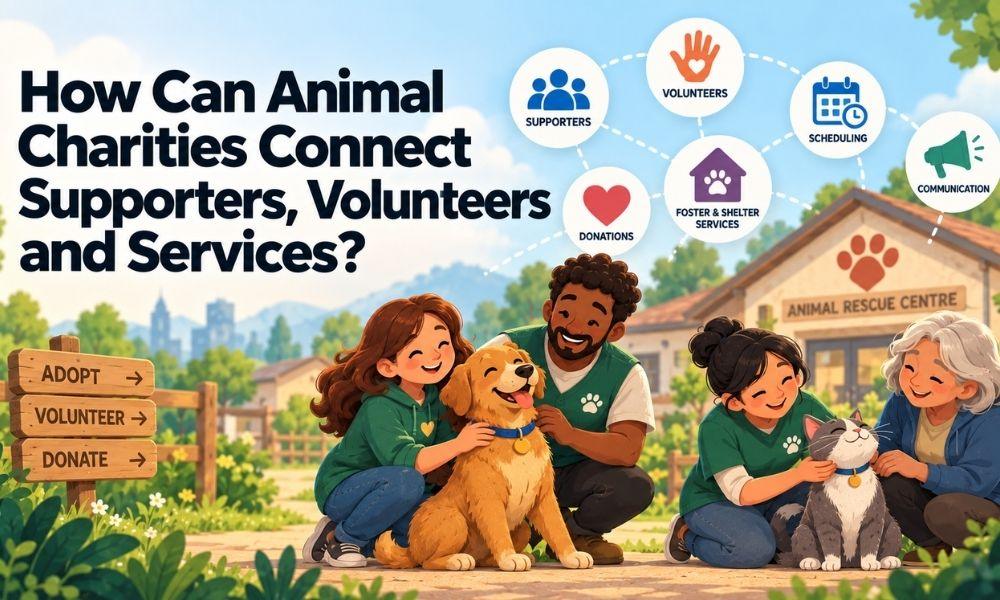
Animal charities rarely have just one type of relationship to manage.
There are donors and regular supporters. Volunteers give their time. Foster carers may provide temporary homes. People enquire about adoption or rehoming. Fundraising teams run appeals and events. Operational teams coordinate services and animal-welfare activity.
The challenge comes when each of those relationships is managed separately.
A donor database, volunteer spreadsheet, foster-carer list, website inbox and separate operational system may each work individually, but together they can create duplicated data, manual administration and poor visibility across the organisation.
Salesforce can provide a connected platform, but only if it is designed around how an animal charity actually works.
At Sweet Potato Tec, our Salesforce for Animal Charities approach is specifically built around donor, volunteer and foster networks, fundraising and animal-welfare operating models rather than treating an animal charity like a conventional commercial organisation.
How can animal charities connect supporters, volunteers and services?
Animal charities can use Salesforce to connect donor and supporter information with volunteering, foster networks, fundraising and relevant animal-welfare processes. A connected CRM can reduce spreadsheets and duplicated administration while improving visibility across teams. The key is to model each relationship properly, so donors, volunteers, foster carers, enquiries and service activity remain distinct while the relevant information is connected.
Why do animal charities end up with disconnected information?
Animal charities can develop disconnected systems because fundraising, volunteering and animal-welfare operations have very different requirements.
Fundraising needs donor history, regular giving, campaigns and communications.
Volunteer coordinators need roles, availability, activity and hours.
Foster teams need to understand who is available and maintain relevant information about foster relationships.
Operational teams may be managing animal, case or service information.
Website enquiries can introduce another source of data.
Events and campaigns add another.
Each team may therefore adopt the tool that solves its immediate problem.
Over time, the organisation can end up with information spread across:
fundraising databases,
spreadsheets,
website forms,
shared inboxes,
volunteer systems,
event platforms,
and operational tools.
That creates a coordination problem.
Sweet Potato Tec’s animal-charity Salesforce proposition specifically addresses this issue. SPT states that it regularly works with animal charities managing donor data, volunteer coordination and service activity across multiple tools, where fragmented information makes reporting difficult and processes fragile.
The answer is not simply to put every spreadsheet into Salesforce.
The organisation first needs to understand the relationships and processes those spreadsheets represent.
How can Salesforce connect donors and supporters with the wider charity?
Salesforce can maintain donor history, engagement and giving information while connecting that supporter with other relevant interactions across the charity.
That matters because someone may have more than one relationship with an animal-welfare organisation.
A donor might also volunteer.
An event attendee may later become a regular supporter.
A volunteer might become a foster carer.
Someone who first contacts the charity about one issue may continue supporting its work in another way.
Creating a separate identity every time that person interacts with another team fragments the relationship.
Sweet Potato Tec’s Salesforce for Animal Charities work includes donor history and engagement, major donor and regular-giving journeys, retention and re-engagement triggers and campaign segmentation.
The aim is to give fundraising teams useful context without pretending every interaction is the same.
A donation remains a donation.
A volunteer shift remains a volunteer activity.
A foster relationship has its own requirements.
The benefit comes from connecting the relevant information around the person rather than flattening everything into one generic activity record.
How can animal charities manage volunteers and foster carers in Salesforce?
Salesforce can provide structured information about volunteers and foster carers so teams can coordinate people more reliably and with less dependence on spreadsheets.
Current Salesforce Nonprofit Cloud volunteer functionality supports areas including volunteer activities, roles, shifts, applications, attendance, availability, locations, skills and engagement history.
For animal charities, foster coordination introduces additional sector-specific requirements.
Sweet Potato Tec’s animal-charity proposition specifically includes:
volunteer roles, hours and activity tracking,
foster-carer profiles and availability,
case notes and communication history,
and coordination designed to reduce spreadsheet dependency.
This creates a much clearer operational picture.
A volunteer coordinator needs to understand what someone is interested in and when they can help.
A foster team may need to understand whether a carer is currently available and maintain the information required by its own processes.
The important point is that “volunteer” and “foster carer” should not automatically be treated as interchangeable roles.
The same person may perform both roles, but the operational requirements can differ.
Salesforce should represent those differences rather than forcing the organisation to maintain duplicate people.
How can Salesforce support applications, checks and onboarding?
Salesforce can support the administrative journey around volunteer or foster applications, required checks, onboarding and training, but the charity itself must determine what those processes require.
A typical process might involve stages such as:
initial enquiry,
application,
review,
required checks,
training,
approval,
onboarding,
and active participation.
Not every animal charity will use the same stages.
Nor will every role have the same requirements.
Someone helping with a fundraising event may go through a different process from someone fostering an animal in their home.
Salesforce can help teams understand where someone is in that journey, assign tasks and maintain relevant statuses.
It should not determine whether an individual is suitable for a particular animal-welfare role or replace the organisation’s safeguarding, assessment or approval procedures.
This distinction is important.
The technology should support the process the charity has established.
It should not invent the process on the charity’s behalf.
Can Salesforce connect animal, case and service information?
Salesforce can be designed to connect relevant operational or service information with the people and processes surrounding it, where that is appropriate to the charity’s model.
But this is where generic CRM design becomes particularly risky.
An animal is not simply another supporter record.
An adoption enquiry is not the same as a donation.
A rehoming process is not the same as a fundraising campaign.
The data model needs to reflect those differences.
An animal-welfare organisation may need to represent information such as:
an animal or case,
the relevant service or process,
an enquiry,
a foster arrangement,
an adoption or rehoming journey,
related communications,
and the people involved.
The precise structure depends on the organisation.
Sweet Potato Tec’s animal-charity proposition explicitly recognises foster and rehoming workflows as part of the operating model Salesforce may need to support.
That does not mean every animal charity should build the same set of records and workflows.
One organisation may operate a rehoming centre.
Another may rely heavily on foster networks.
Another may provide different animal-welfare services entirely.
Salesforce should be configured around the actual service model.
This is the difference between implementing a generic CRM and designing a system for an animal charity.
How can adoption, fostering and rehoming enquiries be connected?
Enquiries can be brought into a structured process so that the relevant team can see what has been requested, what needs to happen next and how that interaction relates to existing information.
An enquiry may begin through:
the charity’s website,
email,
telephone,
an event,
social activity,
or another referral route.
If every enquiry remains in the channel where it arrived, teams can lose visibility.
A website form may sit in an inbox.
A telephone enquiry may be recorded in a spreadsheet.
A foster application may be somewhere else.
Salesforce can provide a central workflow for the information that needs to be managed.
But the workflow needs to distinguish between different intentions.
Someone offering to foster is different from someone asking about adoption.
Someone needing help with rehoming is different again.
The records, questions, assessments and next actions may all differ.
This is why our Salesforce implementation approach starts with stakeholder requirements, existing systems, data and processes before the solution is designed.
The question should not be, “How do we put all enquiries into Salesforce?”
It should be, “What does each enquiry mean, and what needs to happen after we receive it?”
How can website enquiries and internal teams work from the same information?
Website integrations can pass relevant information into Salesforce so teams do not need to re-enter every enquiry manually.
This can reduce one of the most common causes of fragmented data.
Someone completes a website form.
An email reaches a shared inbox.
A member of staff copies the information into a spreadsheet.
Another team later enters the same person into the CRM.
That creates duplication before the relationship has properly started.
A connected process can instead pass the relevant website information into Salesforce, apply agreed matching and validation rules and route it into the appropriate workflow.
Sweet Potato Tec provides Salesforce integration services using direct APIs and middleware where appropriate.
There is also direct nonprofit evidence for this capability.
In SPT’s work with the Charity Retail Association, the organisation’s website and Salesforce had previously operated in silos. SPT implemented real-time website synchronisation and Eventbrite integration, creating more consistent information across platforms and reducing manual errors.
That was not an animal-welfare project and should not be presented as one.
It does demonstrate SPT’s ability to connect public-facing nonprofit systems with Salesforce rather than relying on staff to maintain several versions of the same information.
For an animal charity, the same integration principle can be applied to the specific website journeys the organisation actually operates.
How can Salesforce connect fundraising and animal-welfare activity without confusing them?
Keep the processes distinct while connecting the information that genuinely needs to be shared.
This is one of the most important design principles for animal charities.
Fundraising teams need information about giving, campaigns and supporter engagement.
Operational teams may need information about volunteers, fosters, enquiries and services.
Those teams do not necessarily need access to every piece of information held by the other.
A connected Salesforce environment can provide shared identity and relevant context without turning the entire organisation into one unrestricted database.
For example, fundraising may benefit from knowing that a supporter is also an active volunteer where it is appropriate to use that information.
It does not automatically follow that fundraising users should see detailed operational case notes.
Likewise, an operational user may need basic contact information without needing access to every aspect of a person’s giving history.
The architecture needs to reflect purpose and responsibility.
Sweet Potato Tec’s broader nonprofit Salesforce work is based on connecting donor management, fundraising, volunteers and impact information around the organisation’s operating model.
The principle is connection without unnecessary exposure.
How can events and campaigns become part of the same picture?
Events and campaigns can be connected with Salesforce so charities can understand participation and fundraising as part of wider supporter engagement.
Animal charities may run fundraising events, appeals, community campaigns and other activities involving supporters and volunteers.
If event registrations and campaign data remain outside the CRM, another fragment of the relationship is created.
A connected environment can help answer questions such as:
Did this supporter attend an event?
Did they respond to a particular appeal?
Did they later become a donor?
Are they also volunteering?
Which campaigns are generating engagement?
Which events rely heavily on particular volunteer groups?
The exact reporting depends on the systems and data involved.
SPT’s Charity Retail Association project again provides a useful integration example.
By connecting Eventbrite and Salesforce, event creation and registration information could sync automatically rather than being maintained separately by hand.
For an animal charity, the objective would be to design the equivalent flow around its own events and campaigns.
How can Salesforce improve coordination between animal-charity teams?
Salesforce can provide shared visibility so teams spend less time chasing updates between departments.
That does not mean every team needs the same screen.
A fundraiser needs a fundraising view.
A volunteer coordinator needs a volunteer view.
A foster coordinator may need availability and relationship information.
An operational manager may need service or workflow information.
Leadership may need reporting across several areas.
A well-designed Salesforce environment can give each team the information relevant to its role while keeping the underlying data connected.
That matters when an organisation is heavily dependent on staff knowledge.
If the only person who knows which foster carers are available is away, the process becomes fragile.
If supporter history is understood only by one fundraiser, the same problem exists.
Sweet Potato Tec says its focus when working with animal charities is to consolidate data into Salesforce in a way that remains simple to use, easy to report on and resilient when staff or volunteers change.
That is a much more useful objective than centralising information for its own sake.
How can animal charities report to trustees, funders and stakeholders?
Salesforce can bring operational, fundraising and engagement information into structured reporting so different audiences can see the evidence relevant to them.
Sweet Potato Tec’s Salesforce for Animal Charities work includes:
dashboards for trustees and funders,
outcome tracking by programme,
reporting built from trusted data,
and visibility across services.
That can help an organisation move beyond reports assembled manually from several spreadsheets.
Leadership might need to understand fundraising alongside volunteer capacity and service activity.
A trustee board may need higher-level information about programme performance.
A funder may require evidence relating to a specific service.
Operational managers need more immediate information about what is happening now.
The reporting structure should therefore begin with the questions each audience needs answered.
It should not begin by putting every available Salesforce metric onto one dashboard.
And activity should not automatically be presented as impact.
Recording volunteer hours or the number of enquiries received can be useful, but those figures do not necessarily demonstrate the animal-welfare outcome achieved.
The organisation still needs to define what success means and which evidence genuinely demonstrates it.
Does connecting everything mean everyone can see everything?
No.
Connected data and unrestricted access are not the same thing.
This is particularly important where an animal charity maintains case notes, safeguarding-related information, sensitive supporter data or operational records that should only be available to particular roles.
Salesforce can use role-based access and permissions to control who can work with different information.
Sweet Potato Tec’s Salesforce for Human Services Charities work explicitly includes role-based security and access, reflecting the importance of protecting sensitive service information.
The same architectural principle matters in animal welfare.
Before implementation, decide:
Who needs this information?
Why do they need it?
What should they be able to change?
What should remain restricted?
Which information can be used in aggregated reporting?
What should happen when someone changes role?
A connected platform should improve coordination without weakening appropriate information controls.
What should an animal charity map before implementing Salesforce?
Start with the real operating model rather than a generic CRM template.
A useful discovery process should map:
1. Supporter relationships
How do donors, regular givers, campaign supporters and event attendees currently interact with the organisation?
2. Volunteer journeys
How do people enquire, apply, complete checks or training, become active and record their participation?
3. Foster networks
What information is required about foster carers, their availability and their ongoing relationship with the charity?
4. Animal-welfare services
Which animal, case, service, adoption, fostering or rehoming processes genuinely need to be represented?
5. Website journeys
Which enquiries and applications currently arrive through the website and what happens to them afterwards?
6. Events and campaigns
How are registrations, participation, fundraising and campaign responses currently recorded?
7. Communications
Which teams communicate with each audience, and what information do they need before doing so?
8. Systems and integrations
Where does information live today and which systems genuinely need to remain?
9. Access and security
Which teams should see which information?
10. Reporting
What do frontline teams, management, trustees, funders and other stakeholders need to understand?
Only after those questions are answered should the Salesforce architecture be finalised.
At Sweet Potato Tec, this is fundamental to our Salesforce implementation approach.
Technology should follow the organisation.
For an animal charity, that means Salesforce needs to understand the difference between a donor, volunteer, foster carer, enquiry and animal-welfare service while still connecting the relevant relationships between them.
FAQs
Is Salesforce suitable for animal charities?
Yes. Salesforce can be configured around fundraising, donor and supporter management, volunteer coordination, foster networks, service activity and impact reporting. The important factor is designing it around the charity’s actual animal-welfare operating model rather than applying a generic CRM configuration.
Can Salesforce manage foster carers?
Yes. Sweet Potato Tec’s animal-charity Salesforce proposition specifically includes foster-carer profiles and availability, case notes and communication history. The precise information recorded should reflect the organisation’s own fostering processes and data requirements.
Can Salesforce manage animal records?
Salesforce is flexible enough to support organisation-specific data structures, but the appropriate approach depends on what the charity needs to record and whether Salesforce or a specialist system should own that information. The decision should be made during discovery rather than assuming every animal-welfare record belongs in the CRM.
Can Salesforce manage animal-charity volunteers?
Yes. Salesforce Nonprofit Cloud’s current volunteer-management capabilities include volunteer activities, roles, shifts, applications, attendance, availability, skills and engagement history. SPT’s animal-charity proposition additionally focuses on volunteer roles, hours and activity tracking alongside foster-network coordination.
Can an animal charity connect its website to Salesforce?
Yes. Salesforce can be integrated with websites and other systems through APIs or middleware. Sweet Potato Tec has published nonprofit experience connecting a website with Salesforce in real time through its Charity Retail Association project.
Does an animal charity need to replace all its existing systems?
No. A Salesforce project should identify which existing systems remain useful and which processes should move or connect to Salesforce. Integration can often provide a better solution than replacing a specialist platform purely for the sake of having fewer systems.
Connect the organisation without flattening the differences
Animal charities need connected information, but they do not need every process to become the same process.
A donor is not a foster carer.
A volunteer shift is not an adoption enquiry.
An animal-welfare case is not a fundraising campaign.
What Salesforce can do is connect the relevant relationships between them.
At Sweet Potato Tec, our Salesforce for Animal Charities work is built around this reality. Our published animal-welfare expertise covers donor and supporter management, volunteer and foster-network coordination, fundraising automation, foster and rehoming workflows and impact reporting.
The goal is not simply to create one enormous database.
It is to give each team a reliable view of the information it needs while reducing duplication, spreadsheet dependency and manual handoffs across the organisation.
That starts with the operating model.
Map how supporters engage. Understand how volunteers and foster carers are coordinated. Define the animal-welfare processes that genuinely need to be represented. Identify where website enquiries, events and campaigns fit. Decide who needs access to what.
Then design Salesforce around those relationships.
That is how an animal charity can connect supporters, volunteers and services without losing the differences that make each of those processes work.