
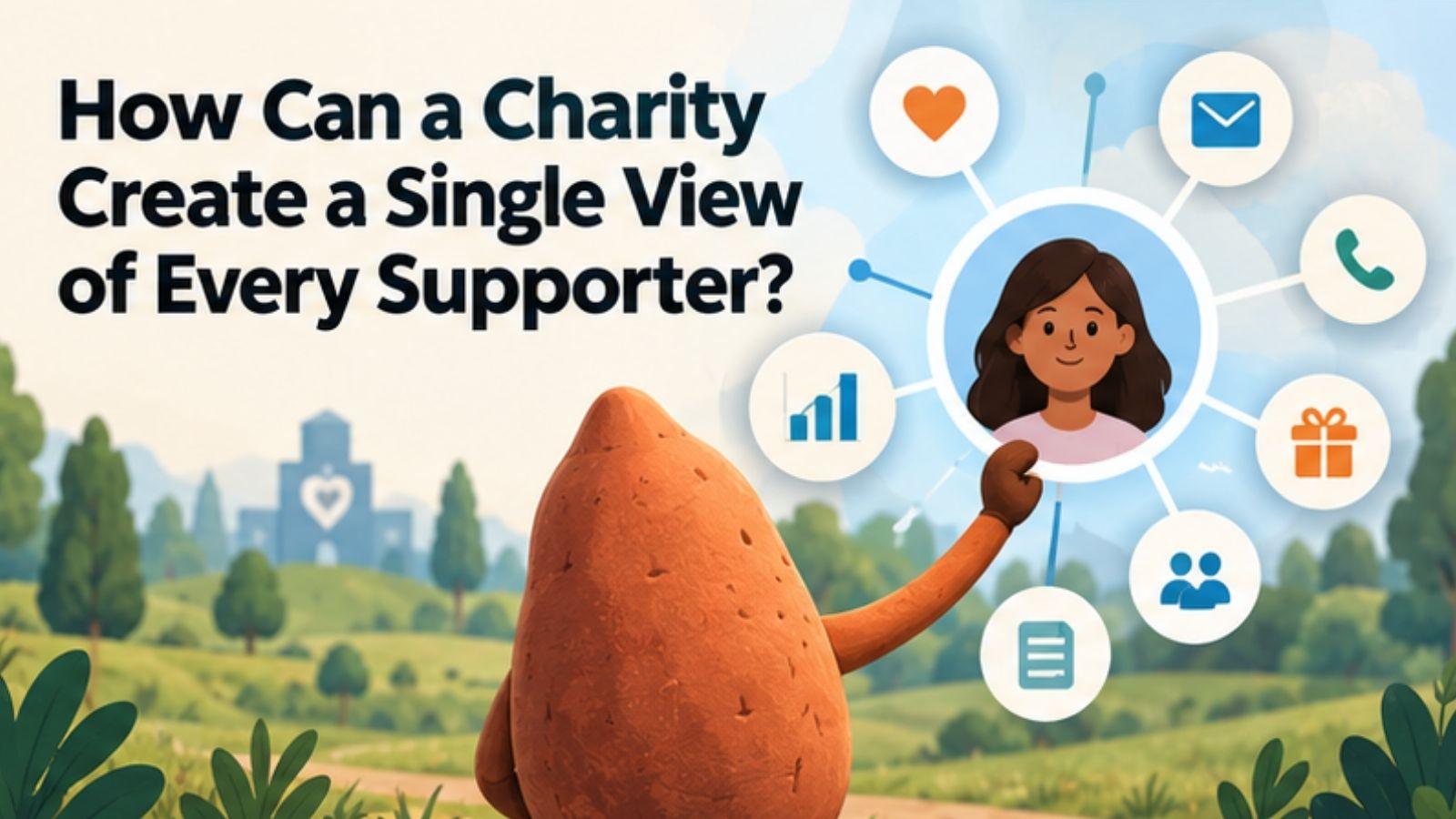
A charity may know far more about its supporters than it appears to.
The problem is often where that information lives.
A donation may sit in a fundraising system. A volunteer application may be stored elsewhere. Event registrations may come through another platform. Website enquiries may reach a shared inbox. Communication preferences may exist in another database again.
The same person can therefore appear several times without the charity recognising the complete relationship.
Creating a single supporter view means connecting those interactions around the individual so authorised teams can understand the relevant relationship accurately.
At Sweet Potato Tec, our Salesforce for Charities & Non-Profits work focuses on that connection. But putting information into Salesforce is not enough. The data needs to be matched, governed and integrated properly if the resulting supporter view is going to be trusted.
How can a charity create a single supporter view?
A charity can create a single supporter view by identifying where supporter data currently lives, resolving duplicate and conflicting identities, establishing clear data-governance rules and connecting relevant systems with a central CRM such as Salesforce. The aim is not simply to centralise records, but to connect fundraising, volunteering, events, services and communications around the right individual while respecting consent, security and access requirements.
What does a single supporter view actually mean?
A single supporter view is a reliable, connected picture of the relevant relationships and interactions a person has with your organisation.
It does not mean forcing everything about that person into one enormous screen.
It means being able to identify that the donor in one process, volunteer in another and event attendee elsewhere may be the same individual.
That distinction is important for charities because people rarely interact with an organisation in only one way.
Someone could:
- make a donation
- volunteer regularly
- attend a fundraising event
- respond to a campaign
- receive a service
- participate in a programme
- communicate with the charity through its website.
Those relationships may also change over time.
If every department maintains its own database, the organisation sees separate versions of the person.
A connected CRM allows those interactions to contribute to a more coherent supporter relationship.
Sweet Potato Tec’s nonprofit Salesforce services include centralising donor and supporter information so charities can understand engagement, giving history and supporter journeys more clearly.
The aim is visibility with purpose.
Different teams do not necessarily need access to every piece of information. Particularly where sensitive service or beneficiary information is involved, access should reflect the person’s role and the charity’s data-protection requirements.
A single supporter view should therefore mean connected and appropriately accessible, not simply visible to everyone.
Why does charity supporter data become fragmented?
Supporter data usually becomes fragmented because different activities introduce different systems over time.
A fundraising team may adopt a donation platform.
Volunteering may use spreadsheets or a separate volunteer-management tool.
Events may have their own registration platform.
Marketing may have a dedicated email system.
Website forms may create emails rather than CRM records.
Service teams may require specialist processes.
Each decision can make sense individually.
The fragmentation becomes visible when the charity needs to understand the relationship across those systems.
Sweet Potato Tec saw a version of this problem in our work with the Charity Retail Association.
The organisation’s website and Salesforce environment operated in silos. Updates were delayed and cross-departmental visibility was limited. Event details were manually posted, while reporting depended on spreadsheets.
SPT connected Salesforce with the website for real-time data synchronisation and integrated Salesforce with Eventbrite for event creation and registration syncing.
The result was shared, up-to-date information across teams, with less manual work and fewer errors.
That project illustrates an important principle.
A single view does not necessarily mean eliminating every specialist platform.
It means designing the data flow so those platforms do not create disconnected versions of the same organisational relationships.
How do duplicate and conflicting supporter records get created?
Duplicate records are created when the same person enters an organisation through different routes and the systems or processes involved do not reliably recognise that they already exist.
For example, imagine a supporter called Sarah donates online using her personal email address.
Several months later, she registers for an event using her work email.
She then applies to volunteer using a shortened version of her name and a new address.
To a person reviewing all three interactions, the connection may be obvious.
To disconnected systems, they may look like three different people.
Duplicates can also be created by:
- different spellings of names
- changed addresses
- changed email addresses
- shared household details
- inconsistent data-entry practices
- imports from external platforms
- historic migrations
- integrations that create new records rather than matching existing ones.
The problem is not simply untidy data.
Duplicate supporter records can distort reporting, fragment giving histories and create inconsistent communications.
Sweet Potato Tec has encountered the consequences of incorrect contact relationships and duplicate data in real Salesforce environments.
In our Data Transformation at Curinos project, incorrect Contacts had been associated with Opportunities during an earlier data migration, affecting reporting and CRM reliability. SPT introduced processes including Salesforce Flows to manage reassociation while preventing duplicates.
Curinos is not a charity example, so its operating model is different.
The relevant lesson is the data problem: a CRM can contain plenty of information and still provide an unreliable view if records are duplicated or connected incorrectly.
What is identity matching and why does it matter?
Identity matching is the process of determining whether records from different sources relate to the same person or entity.
It is fundamental to creating a single supporter view.
The obvious matching field might appear to be an email address.
But people change email addresses. They use work and personal accounts. Couples sometimes share contact details. Names can change. Postal addresses change.
That means identity cannot always be resolved safely using one field.
A charity needs rules for how records are identified and matched, including what happens when the available information is uncertain.
The process may involve combinations of identifiers and, depending on the technology and architecture involved, automated matching alongside manual review.
The important thing is confidence.
An incorrect match can be just as damaging as a duplicate.
If two different people are mistakenly combined, giving history, communications or other information can become associated with the wrong individual.
Before building a single supporter view, the organisation should therefore establish:
What makes us confident that two records represent the same person?
What happens when we are not confident?
Which system owns the authoritative version of particular information?
Who can review and correct matching problems?
Those are governance questions as much as technical ones.
Why won’t moving everything into Salesforce automatically solve poor data?
Because a CRM can centralise bad data just as effectively as good data.
Importing five databases into Salesforce without first understanding duplicates, inconsistencies and ownership can simply create one large database containing the same problems.
This is why Sweet Potato Tec’s Salesforce implementation work includes clean data and governance alongside configuration and integrations.
Before migration or consolidation, the organisation needs to understand what the information means.
Which records are duplicates?
Which fields are still used?
Which source should be trusted where values conflict?
Which historic information genuinely needs to be retained?
Which records should be reviewed before migration?
Which information requires restricted access?
How should new information be entered after go-live?
The last question is particularly important.
A one-off data-cleaning exercise does not create sustainable data quality.
If website forms, imports and staff processes continue creating duplicates, the supporter view will gradually deteriorate again.
Data quality therefore needs controls at the point information enters the organisation.
The goal is not just to clean yesterday’s data.
It is to stop tomorrow’s data becoming fragmented again.
How can fundraising, volunteering, events and services be connected?
They can be connected by designing the CRM around the person and their relationships rather than creating an entirely separate identity for each department.
Consider one supporter.
They first attend an event.
Later they make a donation.
They begin volunteering.
Eventually, they take part in another programme run by the organisation.
Those activities should not automatically result in four disconnected supporter identities.
Instead, the CRM should allow relevant engagement to be associated with the appropriate person while maintaining the structures required for each activity.
Sweet Potato Tec’s nonprofit proposition reflects this wider model.
Our Salesforce for Charities & Non-Profits work covers donor and supporter management, fundraising, volunteer engagement and impact reporting.
For organisations delivering services, there are additional considerations.
Our Salesforce for Human Services Charities work recognises the need for secure case handling, safeguarding-aware processes and role-based access.
That matters because a single supporter view should never become an excuse to expose sensitive information unnecessarily.
The fundraising team may need to know that an individual has a relationship with the organisation.
That does not mean it automatically needs access to confidential service or case information.
The architecture needs to connect what should be connected while protecting what should remain restricted.
How should charities manage consent and communication preferences?
Consent and communication preferences need to form part of the supporter-data model rather than being treated as an afterthought.
A connected supporter view can help prevent different departments maintaining contradictory communication information.
For example, if one system says someone has opted out of a particular communication while another system continues treating them as contactable, the organisation has a data-governance problem.
The charity needs to establish:
- what communication preferences it records
- where those preferences are captured
- which system is authoritative
- how updates move between connected platforms
- how changes are timestamped or otherwise recorded where required
- which teams and processes use that information.
UK charities must also consider their obligations under applicable data-protection and electronic-marketing rules.
The CRM architecture should support the organisation’s approved policies rather than attempting to define the legal basis for communication itself.
A practical technical question is:
If a supporter changes their preference in one place, what happens everywhere else?
If the answer is that somebody manually updates several databases, the organisation does not yet have a reliable connected preference model.
What role do integrations play in creating a single supporter view?
Integrations allow information to move between the systems a charity still needs, reducing manual re-entry and helping Salesforce maintain a more current view.
The objective is not to integrate everything indiscriminately.
It is to identify which information needs to move, in which direction, at what frequency and under which rules.
Sweet Potato Tec provides Salesforce integration services covering API integration, middleware, ETL and data synchronisation.
Where enterprise integration requirements are more complex, SPT also works with middleware technologies including Boomi.
The Charity Retail Association demonstrates the principle in a nonprofit environment.
SPT connected Salesforce with the charity’s website so information could synchronise in real time. Eventbrite was also integrated with Salesforce to automate event creation and registration syncing.
That reduced the silos between platforms without requiring every function to be rebuilt inside Salesforce.
For another charity, the landscape might include:
- a website
- online forms
- a donation platform
- a payment provider
- an email or marketing platform
- an events system
- a volunteer system
- finance software
- service-delivery applications.
Before building integrations, map the data journey.
Where is information first created?
Where should the master record live?
Which system is allowed to update it?
What should happen when a match already exists?
What should happen when one cannot be found?
What happens when an integration fails?
Those decisions determine whether integration creates a single supporter view or simply moves duplicate data faster.
What is the role of data governance?
Data governance keeps the supporter view reliable after the initial implementation is complete.
It establishes the rules for how information is created, maintained, accessed and corrected.
That includes questions such as:
Who owns supporter-data quality?
Which fields are mandatory?
What naming or formatting standards apply?
Who can merge records?
How are suspected duplicates reviewed?
Which system is authoritative for different information?
How are integrations monitored?
How long should different information be retained?
Who should have access to sensitive records?
What happens when someone identifies incorrect information?
Without clear ownership, data-quality problems can become everybody’s concern but nobody’s responsibility.
Governance does not need to mean creating a huge administrative framework.
For many charities, a small number of clear rules, ownership decisions and regular checks can make a substantial difference.
The important point is that the organisation treats data quality as an ongoing operational responsibility.
A single supporter view is not a one-time technology project.
It has to remain trustworthy.
How does a single supporter view improve fundraising and communications?
A reliable supporter view gives teams better context for deciding how and when to engage.
Fundraisers can understand relevant giving and engagement history rather than seeing only an isolated transaction.
Volunteer teams can understand someone’s volunteering relationship.
Event teams can work with consistent registration information.
Communications teams can segment audiences using more reliable data and appropriate preferences.
Leadership can report using information drawn from a more consistent foundation.
The benefit is not simply “personalisation”.
It is avoiding decisions based on incomplete information.
For example, an organisation may otherwise send an introductory supporter message to somebody who has volunteered for years.
A fundraising team may fail to recognise an engaged event participant.
Different departments may contact the same person independently because neither can see the other’s activity.
Or a supporter may need to repeat information because one team cannot access the appropriate context already held elsewhere.
A connected view reduces those blind spots.
Sweet Potato Tec’s Charity Retail Association project demonstrates this organisational benefit. Once Salesforce, the website and Eventbrite were connected, cross-functional teams could work from shared, current information rather than siloed systems and manual spreadsheets.
That is what a single view should ultimately achieve.
Not more data.
Better use of the data the organisation already has.
What are the practical stages for creating a single supporter view?
Start with discovery, not technology.
A practical programme usually needs to answer several questions in sequence.
1. Identify the relationships you need to understand
Define what “supporter” means in your organisation.
Donors may be only one part of the picture. Include volunteers, event attendees, campaigners, members and other relevant relationships.
Where service users or beneficiaries are involved, establish from the outset what information should be connected and what requires additional protection.
2. Map where supporter information currently lives
Document the databases, spreadsheets, website forms, event platforms, donation tools and other systems containing relevant information.
3. Assess data quality
Identify duplicate records, inconsistent values, missing identifiers and historic information that may no longer be useful.
4. Define identity and governance rules
Agree how people are matched, which systems own particular information and who is responsible for resolving exceptions.
5. Design the CRM data model
Decide how Salesforce should represent people and their different relationships with the organisation.
6. Design the integrations
Determine which systems remain and what information needs to move between them.
7. Clean, migrate and test the data
Do not assume successful import means successful migration. Test whether relationships, preferences and history remain meaningful after the move.
8. Establish ongoing governance
Monitor duplicates, integration errors, data quality and user behaviour after launch.
At Sweet Potato Tec, this is why our Salesforce implementation process begins with systems, data, processes and goals rather than jumping immediately into configuration.
A single supporter view is an organisational design problem before it is a Salesforce build.
FAQs
Does a single supporter view mean putting all charity data into Salesforce?
No. A charity can retain specialist platforms where they serve a useful purpose. The objective is to establish which information needs to be available in Salesforce and how the relevant systems should exchange data. The Charity Retail Association, for example, retained Eventbrite while SPT integrated it with Salesforce.
How do charities deal with supporters who use different email addresses?
Email can be a useful identifier, but it should not always be treated as definitive proof of identity. Charities need matching rules that consider the information available and a process for ambiguous cases. The appropriate matching strategy depends on the organisation’s data and systems.
Can Salesforce automatically remove duplicate supporter records?
Salesforce provides capabilities that can support duplicate management, but technology alone does not remove the need for data-quality rules. Charities still need to define how potential duplicates are identified, when records should be merged and how uncertain matches are reviewed.
Should beneficiary information appear in the same view as fundraising data?
Not automatically. Where a charity handles sensitive beneficiary or service information, access should reflect the organisation’s data-protection, safeguarding and operational requirements. Salesforce can support role-based access, but the charity needs to define what different teams genuinely need to see.
Do charities need Salesforce Data Cloud to create a single supporter view?
Not necessarily. The appropriate architecture depends on the number and complexity of data sources, identity-resolution requirements, volumes and use cases. Some charities can create a useful connected view through Salesforce CRM architecture and well-designed integrations without adding another platform. More complex data environments may justify additional data capabilities.
How long does it take to create a single supporter view?
There is no reliable standard timeframe. A charity with a few relatively clean data sources has a very different project from an organisation with years of duplicated records, several platforms and complex integrations. Discovery and data assessment are needed before a realistic implementation plan can be produced.
A single supporter view starts with understanding the supporter
Creating a single supporter view is not about moving every spreadsheet into Salesforce and declaring the data centralised.
It means recognising that one person can have several relationships with your charity and designing the data around that reality.
They may donate.
They may volunteer.
They may attend events.
They may engage with campaigns or services.
Those interactions can provide valuable context when they are connected appropriately, but only if the underlying identities are reliable, communication preferences are respected and access to sensitive information is controlled.
At Sweet Potato Tec, our Salesforce for Charities & Non-Profits work helps organisations centralise donor and supporter information while connecting fundraising, volunteer engagement and impact data.
Our work with the Charity Retail Association shows the practical difference connected systems can make. Salesforce, the website and event information had previously operated in silos. By integrating the platforms and automating data flows, SPT enabled teams to work from shared, up-to-date information while reducing manual tasks and errors.
But integration is only one part of the answer.
A sustainable supporter view also requires clean data, sensible identity rules, appropriate permissions and ongoing governance.
Start by mapping the supporter relationships and information you already have.
Then decide what needs to be connected, what needs to be cleaned and what needs to remain protected.
The technology comes after those decisions.
That is how a charity moves from having information about its supporters in many different places to having a supporter view its teams can actually trust.