
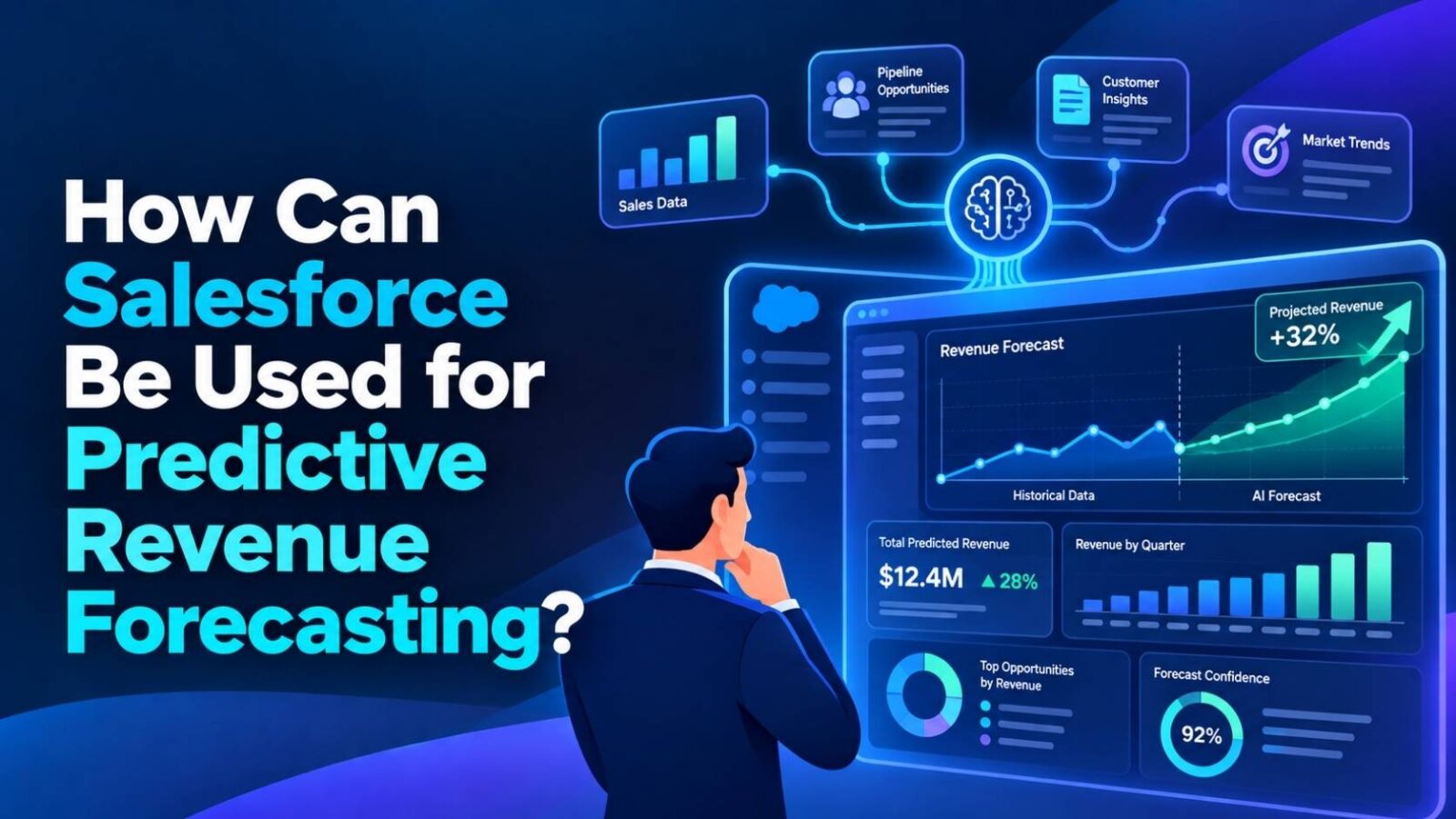
Salesforce can be used for predictive revenue forecasting by combining historical and current CRM data with CRM Analytics and predictive models to estimate future revenue outcomes, identify the factors influencing those outcomes and give sales, finance and leadership teams a forward-looking view of performance.
This goes beyond adding up the value of open opportunities.
At Sweet Potato Tec, we have implemented predictive forecasting directly within Salesforce CRM Analytics. In one project for a global enterprise software company, we built a 48-month forecasting model using Einstein Discovery to predict revenue at account-product level across both renewals and new business.
The important lesson from that project is that predictive forecasting does not begin with AI.
It begins with the data.
Before Salesforce can produce useful forward-looking insights, an organisation needs to establish what it is trying to predict, bring the relevant revenue data together and make sure that information is reliable enough to support a predictive model.
Key takeaway: how does predictive revenue forecasting work in Salesforce?
Salesforce predictive revenue forecasting can combine CRM Analytics, Revenue Intelligence and Einstein Discovery with an organisation’s sales and revenue data.
CRM Analytics prepares and unifies the relevant datasets. Einstein Discovery can analyse patterns within that data and create predictive models around defined business outcomes. Revenue Intelligence can then help sales teams understand pipeline and forecasting information alongside wider revenue insights.
The result can be a forecasting process based not only on what is currently in the pipeline, but on patterns contained in historical and current business data.
What is predictive revenue forecasting?
Predictive revenue forecasting uses historical and current data to model likely future revenue outcomes.
That is different from simply asking salespeople what they expect to close.
Traditional forecasting often depends heavily on open opportunities, sales stages, close dates and judgement from individual salespeople or managers. Those inputs remain useful, but they can provide a limited view of what may happen further ahead.
Predictive forecasting introduces another layer.
Historical patterns can be analysed alongside current CRM information to identify relationships within the data and estimate future outcomes.
Salesforce’s Einstein Discovery is designed for this type of analysis. It uses statistical modelling and supervised machine learning to identify patterns, predict future outcomes and provide insights into factors that may influence those outcomes.
Within Salesforce Revenue Intelligence, CRM Analytics and forecasting capabilities can also give sales teams a consolidated view of pipeline and performance.
For organisations already capturing meaningful revenue data in Salesforce, that creates an opportunity to move from reporting what has happened towards modelling what may happen next.
How is predictive forecasting different from a normal Salesforce sales forecast?
The main difference is the information used to produce the forecast and the question it is trying to answer.
A conventional sales forecast is generally centred on the current pipeline. It helps an organisation understand how much revenue sales teams expect from opportunities being worked now.
Predictive forecasting can use broader historical patterns and multiple data points to estimate future outcomes.
That distinction becomes particularly useful when organisations want to forecast beyond their immediate opportunity pipeline.
Sweet Potato Tec’s Revenue Intelligence project for a global software company demonstrates this clearly.
The organisation’s existing forecasting process relied on spreadsheets. Renewals were difficult to distinguish from net-new business, revenue-critical information was fragmented across Salesforce objects and leadership lacked a reliable way to model revenue beyond the immediate pipeline.
Sweet Potato Tec built a 48-month forecasting model inside Salesforce CRM Analytics.
Instead of simply visualising the existing pipeline more clearly, the project used predictive modelling to provide a longer-term view of future revenue.
That is a much more useful distinction than treating every Salesforce forecast as the same thing.
Which Salesforce products can be used for predictive revenue forecasting?
The appropriate Salesforce architecture depends on the organisation and forecasting objective, but CRM Analytics, Revenue Intelligence and Einstein Discovery can all play important roles.
Salesforce CRM Analytics
Salesforce CRM Analytics provides the analytics layer in which data can be brought together, transformed and explored.
For predictive forecasting, this matters because the information required may sit across several Salesforce objects or external sources.
An organisation may need Opportunity data alongside Accounts, Products, Users, renewals or other commercial information.
Sweet Potato Tec’s CRM Analytics work includes data modelling and integration, interactive dashboards, embedded analytics, governance and predictive intelligence.
Einstein Discovery
Einstein Discovery provides predictive modelling within the Salesforce analytics ecosystem.
Salesforce describes Einstein Discovery as using statistical modelling and supervised machine learning to analyse business data, predict outcomes and identify factors influencing those predictions.
A model is built around a defined outcome.
That principle is important.
You do not simply “turn on AI” and receive a useful revenue forecast. The organisation needs to determine what it wants to predict and prepare the relevant data around that objective.
Revenue Intelligence
Salesforce Revenue Intelligence combines CRM Analytics dashboards and analytics with sales and pipeline capabilities.
For sales teams, it can provide visibility into pipeline health, performance and forecasting while bringing analytics closer to the operational sales process.
Sweet Potato Tec’s CRM Analytics services include Revenue Intelligence work focused on pipeline health, forecast accuracy and deal momentum.
The products are useful, but the architecture should follow the forecasting requirement rather than the other way around.
What data do you need for predictive revenue forecasting?
You need enough reliable historical and current data to represent the revenue outcome you want to predict and the factors that may influence it.
The exact dataset will vary between organisations.
For Sweet Potato Tec’s global software company project, relevant data was distributed across Opportunities, Products, Accounts and Users.
SPT unified those objects using CRM Analytics recipes and applied transformations, renewal flags and data-quality checks before predictive modelling.
That detail is important because it shows what predictive forecasting involves in practice.
The model did not simply consume raw Salesforce records.
The data had to be prepared.
For another organisation, the relevant information may be different. A subscription business might need a particularly clear distinction between new and recurring revenue. A business selling several product families may need product-level patterns. An organisation operating across regions may need geography included in the analysis.
Start with the forecasting question.
Then work backwards to identify which data is needed to answer it.
Why is data quality so important for Salesforce predictive forecasting?
A predictive model learns from the data it is given. Poor underlying data therefore weakens the foundation of the forecast.
In Sweet Potato Tec’s Revenue Intelligence project, the organisation had duplicated, missing and inconsistent Salesforce records. Those issues weakened reporting before predictive modelling was introduced.
SPT’s solution therefore included data-quality work alongside the predictive model.
Duplicates and missing product mappings were identified. Inconsistent renewal flags were addressed. Governance was established to improve trust in reporting.
This is why an organisation struggling to trust its existing Salesforce reports should not assume that adding predictive analytics will immediately solve the problem.
The underlying issues need to be understood first.
If opportunity values are unreliable, product mappings are incomplete or renewal information is inconsistent, those problems can affect the data being used to train and operate the model.
Our Salesforce CRM Analytics approach includes data modelling, integration and governance for this reason.
Predictive forecasting is only as useful as the information on which the predictions depend.
Can Salesforce forecast renewals separately from new business?
Yes, if the underlying data and model are designed to distinguish them.
This was a specific requirement in Sweet Potato Tec’s predictive forecasting project.
The global software company had difficulty separating renewals from net-new business, which created uncertainty around recurring revenue projections.
Sweet Potato Tec introduced renewal flags as part of the CRM Analytics data preparation and trained Einstein Discovery models to predict revenue at account-product level across both renewals and new business.
That distinction gave the organisation greater clarity around recurring revenue.
For SaaS and other recurring-revenue businesses, this can be particularly important because different types of revenue may behave differently.
A renewal does not necessarily have the same risk profile, timing or influencing factors as a completely new sale.
Treating them as a single revenue category can therefore limit the usefulness of a long-range forecast.
The data model should reflect the commercial reality the organisation is trying to predict.
Can Salesforce forecast revenue beyond the current pipeline?
Yes. Predictive modelling can be designed to estimate future outcomes beyond opportunities currently sitting in the immediate sales pipeline, provided there is sufficient relevant data to support the model.
That was one of the central objectives of SPT’s Revenue Intelligence Transformation.
The client’s previous approach gave leadership limited forward-looking visibility. SPT designed a 48-month forecasting application inside CRM Analytics, with Einstein Discovery models predicting revenue at account-product level.
The resulting model was designed to roll forward into future years.
This does not mean Salesforce can know future revenue with certainty.
A predictive forecast is a model, not a guarantee.
Its usefulness comes from identifying patterns in available data and providing a consistent, evidence-based view that can support planning.
The organisation should therefore treat predictions as decision support rather than absolute outcomes.
Can Salesforce combine data from different sources for revenue forecasting?
Yes. CRM Analytics can bring Salesforce and external data together into an analytics layer, although the appropriate architecture depends on where the relevant information lives and how it is governed.
This matters because the complete revenue picture may not sit inside one Salesforce object, or even entirely inside Salesforce.
Sales information may sit in Opportunities. Product information may sit elsewhere. Finance systems may contain additional revenue information. Other operational systems may hold data relevant to the forecasting objective.
Sweet Potato Tec’s CRM Analytics capability includes data modelling and integration specifically to create a trusted analytical foundation from Salesforce and external data sources.
The principle is straightforward: do not restrict the model to a dataset simply because it is convenient.
First identify which information genuinely matters to the forecast. Then determine how it can be brought together reliably.
How does Einstein Discovery create a predictive revenue model?
Einstein Discovery models relationships between a defined business outcome and the factors that may influence it.
Salesforce describes those influencing factors as explanatory variables.
For a revenue-related model, the precise outcome and explanatory variables depend on the forecasting objective and available data.
The process therefore begins by defining the outcome.
What exactly are you trying to predict?
Then the relevant data is prepared in CRM Analytics. Einstein Discovery analyses relationships within that dataset and trains a model around the selected outcome.
Salesforce provides model performance metrics that can be used to evaluate how effectively the model predicts future outcomes.
Sweet Potato Tec followed this approach in its global software company project by preparing Salesforce data, building predictive datasets and training Einstein Discovery models around account-product revenue.
The model was therefore designed around the client’s commercial question rather than using a generic forecasting template.
What should a predictive revenue dashboard show?
A predictive dashboard should help users understand the forecast, compare it with real performance and investigate the factors behind it.
A single future-revenue number is rarely enough.
Sweet Potato Tec’s predictive forecasting project included interactive dashboards showing predicted versus actual revenue, with drill-down filters across accounts, regions and product lines.
That made the forecast explorable.
Users could move from the high-level prediction into the underlying commercial dimensions.
For leadership, this can make predictive forecasting more useful for planning because the model becomes part of an analytical process rather than a number produced somewhere in the background.
The right dashboard will depend on the audience.
Sales leaders may need pipeline and account-level visibility. Finance may need a different level of aggregation or export. Executives may need longer-term trends and scenarios.
The dashboard design should therefore follow the decisions users need to make.
Can predictive forecasting replace sales judgement?
No. Predictive forecasting should support human decision-making rather than be treated as an infallible replacement for it.
A model can identify patterns that are difficult to see manually and apply a consistent analytical approach across large volumes of data.
People still provide context that may not yet be represented in the model.
A major commercial event, new market condition, strategic account development or internal business change may alter the interpretation of the forecast.
The strongest approach is therefore to give teams better evidence.
Salesforce Revenue Intelligence and CRM Analytics can bring predictive insight into the same environment where sales and revenue decisions are being made, allowing teams to compare model outputs with operational knowledge.
Predictive forecasting is valuable because it adds another source of intelligence to planning.
It should not remove scrutiny from the process.
How can predictive forecasting help Sales, Finance and Operations work from the same numbers?
A shared predictive model can reduce the problem of different teams maintaining separate versions of the forecast.
This was another issue addressed in Sweet Potato Tec’s Revenue Intelligence project.
The original spreadsheet-based process made forecasting manual and inconsistent. Following implementation, Sales, Finance and Operations could align around a single predictive forecast.
SPT also enabled CSV and Excel exports for Finance, recognising that operationalising predictive forecasting sometimes means supporting the ways different teams need to consume the information.
This is an important point.
The objective should not be to build an impressive analytics model that only a small technical team understands.
The forecast needs to become usable within the organisation’s actual planning process.
That means considering who needs the information, where they need it and how often it needs to be refreshed.
Does a predictive revenue model need ongoing maintenance?
Yes. A predictive forecasting model should be monitored, refreshed and reviewed as the underlying data and business change.
Sweet Potato Tec’s implementation included scheduled prediction refreshes, documentation for monthly model retraining and a governance framework around the forecasting process.
SPT also provided continuous support, monitoring refreshes and iterating with stakeholders as Salesforce introduced new AI and Revenue Intelligence capabilities.
This matters because the business environment does not remain static.
Products change. Revenue patterns evolve. New markets appear. Data structures change. The relationship between historical factors and future outcomes can also change.
Predictive forecasting should therefore be treated as an operational capability rather than a one-off analytics project.
Someone needs ownership of the data, the model, the refresh process and the way predictions are used.
What should you assess before implementing predictive revenue forecasting in Salesforce?
Start with the business question and the quality of the available data.
Before building a predictive model, an organisation should be able to answer:
What are we trying to predict?
Is the objective next-quarter revenue, longer-range account-product revenue, renewal value, deal outcomes or something else?
Which data influences that outcome?
Identify where it lives and whether important information sits outside Salesforce.
Can we trust that data?
Assess duplicates, missing information, inconsistent categorisation and other issues that could weaken the model.
Do we have enough useful historical information?
Predictive modelling depends on patterns in data. The required volume and history will depend on the use case.
How will the prediction be used?
Determine which teams need the forecast and which decisions it needs to support.
How will model performance be assessed?
Agree how predictions will be compared with actual outcomes and how the model will be reviewed.
At Sweet Potato Tec, our Salesforce consulting work includes reporting and forecasting improvement alongside Salesforce health checks, process optimisation and transformation planning.
That wider assessment can be important where an organisation wants predictive analytics but is not yet confident in the Salesforce foundations underneath it.
FAQs
What is Salesforce predictive revenue forecasting?
Predictive revenue forecasting uses Salesforce and related business data to model likely future revenue outcomes. CRM Analytics can prepare and unify data, while Einstein Discovery can use statistical modelling and machine learning to predict defined outcomes and identify factors associated with them.
Is Salesforce Revenue Intelligence the same as CRM Analytics?
No. They are related but not identical. Salesforce Revenue Intelligence brings together sales-focused analytics and forecasting capabilities and includes CRM Analytics functionality. CRM Analytics is Salesforce’s broader analytics platform for bringing data together, creating dashboards and supporting predictive intelligence.
Can Salesforce predict revenue several years ahead?
A predictive model can be designed for longer-range forecasting where the data and business use case support it. Sweet Potato Tec has implemented a 48-month predictive forecasting model in Salesforce CRM Analytics for a global software company. Longer forecasting horizons still involve uncertainty, so predictions should be interpreted as analytical decision support rather than guaranteed future revenue.
Can Salesforce predict renewals?
Yes. Sweet Potato Tec has implemented an Einstein Discovery model that predicted account-product revenue across renewals and new business. The underlying data preparation included renewal flags so recurring revenue could be distinguished more clearly from net-new business.
Do we need clean Salesforce data before using predictive forecasting?
You need data that is sufficiently reliable for the forecasting objective. Predictive analytics does not remove the need for data-quality work. In SPT’s Revenue Intelligence project, duplicates, missing product mappings and inconsistent renewal flags were addressed alongside the predictive implementation.
Can Salesforce predictive forecasting use external data?
CRM Analytics can combine Salesforce and external data sources. Whether external data should be included depends on the forecasting objective, its relevance, data quality and the architecture required to bring it into the analytical model.
Move from reporting revenue to anticipating it
Salesforce can do more than tell you what has already happened or total the value currently sitting in the pipeline.
With the right data foundation, Salesforce CRM Analytics and predictive modelling can help organisations build a more forward-looking view of revenue.
But the technology is only one part of the work.
The forecasting objective needs to be clearly defined. Revenue data needs to be brought together. Data-quality problems need to be addressed. The predictive model needs to be evaluated. Dashboards need to make the output useful to decision-makers. And the model needs ongoing governance once it is in production.
Sweet Potato Tec has already applied that approach in practice.
For a global enterprise software company, we designed and implemented a 48-month predictive revenue forecasting model inside Salesforce CRM Analytics, using Einstein Discovery across account-product revenue, renewals and new business. The project brought previously fragmented revenue data together, strengthened data governance and gave Sales, Finance and Operations a shared predictive view.
Our Salesforce CRM Analytics work combines data modelling, predictive intelligence, dashboards, Revenue Intelligence and governance to turn Salesforce data into information organisations can actually use for planning.
If your current forecasting process still depends on spreadsheets, manual consolidation or the immediate sales pipeline alone, the first question is not whether you need a more sophisticated dashboard.
It is whether the data already in and around Salesforce can be turned into a reliable model of what may happen next.