
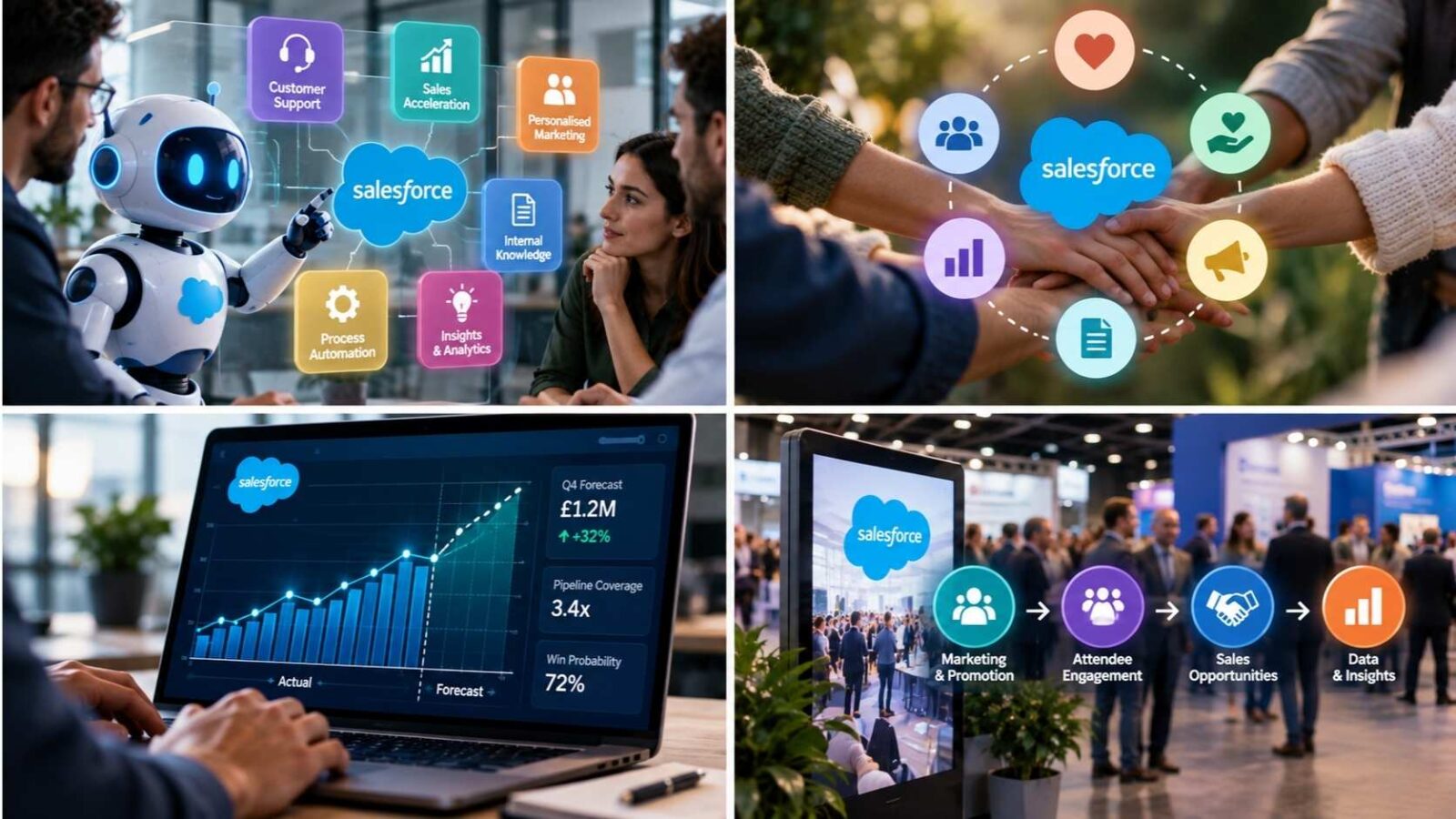
Salesforce can give an events or exhibitions business a connected view of the relationships and revenue surrounding an event. Sales teams can manage sponsors and exhibitors, marketing teams can work with consistent audience data, registration information can flow between systems, and leadership can see commercial activity without manually combining spreadsheets from different departments.
The real value comes from connecting those processes.
An event business rarely has a shortage of data. The problem is that the data is often spread across the CRM, registration platform, marketing tools, website, finance system and operational workflows.
At Sweet Potato Tec, we design Salesforce around those connections. Our work with CyberRisk Alliance, for example, created a Salesforce ecosystem supporting sales, finance, fulfilment, events, marketing and customer success rather than treating each function as a separate technology project.
For event and exhibition businesses, the question is therefore not simply, “Can we use Salesforce to manage events?”
It is: “How can Salesforce connect the commercial, marketing, attendee and operational data surrounding our events?”
Key takeaway: how can Salesforce support an events or exhibitions business?
Salesforce can act as the CRM and commercial data layer connecting the people and processes surrounding an event.
Depending on the organisation, that can include sponsors, exhibitors, advertisers, attendees, speakers, prospects, customers and other stakeholders. Salesforce can also connect with marketing, registration, finance and operational systems so that teams do not have to maintain separate versions of the same information.
The objective is not necessarily to make Salesforce perform every event-management function.
It is to create a connected architecture in which event activity contributes to a useful, long-term view of customers, prospects, engagement and revenue.
Why do events businesses struggle with disconnected data?
Because a single event can involve several teams using several different systems.
The sales team may be managing sponsorship and exhibition opportunities in a CRM. Marketing may be running campaigns elsewhere. Registrations may sit in an event platform. Finance may have another view of bookings and revenue. Event operations may maintain separate information about speakers, exhibitors or fulfilment.
Each system can work individually while the organisation as a whole still lacks a reliable picture.
The problem becomes particularly visible when teams begin exporting data to spreadsheets simply to reconcile what is happening.
Who has registered?
Which sponsors have signed?
Which exhibitors need follow-up?
Which attendees are connected with existing accounts?
Which prospects engaged with a campaign but did not attend?
What revenue has been secured?
Who should sales contact after the event?
Which customers should be approached about the next edition?
If answering those questions requires information from several teams and systems, the problem is not necessarily a lack of data.
It is a lack of connection.
Sweet Potato Tec’s Salesforce implementation approach starts by understanding existing systems, data, processes and business goals for exactly this reason. The Salesforce design needs to reflect the way the organisation operates rather than creating another isolated platform.
How can Salesforce connect event sales with the rest of the business?
Salesforce Sales Cloud can provide a structured commercial view of the accounts, contacts, opportunities and revenue associated with events.
For an exhibition or B2B event organiser, that might include relationships with sponsors, exhibitors and key commercial accounts.
The important point is that the opportunity should not exist in isolation.
Sales teams need to understand the account behind it, previous activity, relevant contacts and where the opportunity sits within the wider commercial relationship.
Sweet Potato Tec’s Sales Cloud work focuses on connecting lead, account, opportunity and quote information so that sales teams can work from shared commercial data rather than disconnected records.
For event-led media businesses, there may be additional complexity.
Sweet Potato Tec’s Salesforce for Media & Entertainment proposition includes advertising and sponsorship pipelines, bundled products, subscriptions, renewals and multi-channel revenue.
That matters where an organisation sells more than exhibition space.
A customer relationship may include sponsorship, advertising, content, subscriptions and event participation. Salesforce can provide the commercial structure that allows those revenue streams to be understood together.
Can Salesforce help manage sponsors and exhibitors?
Yes. Salesforce can be configured to manage sponsor and exhibitor relationships through the commercial lifecycle, provided the data model reflects how the organisation actually sells.
That can begin with prospecting and opportunity management and continue through the information required once a commercial agreement has been secured.
The precise process varies considerably between events businesses.
A simple sponsorship opportunity may be straightforward. A large exhibition may involve different packages, products, stakeholders, fulfilment requirements and future rebooking opportunities.
This is why the Salesforce design should follow the commercial model rather than assuming that every event sale can be represented in exactly the same way.
Sweet Potato Tec’s Managed Services for Events & Media Companies are specifically structured around sponsorship, exhibitor and sales operations before, during and after events.
That lifecycle is important.
The value of Salesforce is not just recording that an exhibitor bought space this year. It is retaining the commercial relationship and activity needed to support future engagement.
How can Salesforce connect sales and marketing around an event?
Sales and marketing should be able to work from connected information about accounts, contacts, campaigns and engagement.
Without that connection, event marketing can generate valuable signals that never become useful commercial context.
Someone may respond to a campaign, register for an event, attend a particular activity and later become a relevant sales prospect. If those interactions remain disconnected, the sales team may see only a name and email address rather than the relationship developing around that person or account.
The reverse problem also occurs.
Marketing may not know that a contact belongs to an important commercial account, is already in an active sales conversation or has a history with the organisation.
Sweet Potato Tec’s work with CyberRisk Alliance demonstrates the importance of connecting these functions.
Before the transformation, marketing and fulfilment teams lacked access to the information they needed and reporting was fragmented. SPT created a connected Salesforce ecosystem supporting sales, finance, fulfilment, events, marketing and customer success, with Marketo among the integrated platforms.
The result was not simply a better sales database.
Teams gained access to shared data.
For event businesses, that cross-functional visibility is what turns event engagement into useful CRM information.
Can attendee and registration data be connected with Salesforce?
Yes. Salesforce can be integrated with event and registration platforms so that relevant registration information flows into the CRM.
Sweet Potato Tec has implemented this in practice.
In our work with the Charity Retail Association, Salesforce and the organisation’s website previously operated in silos, while event information required manual administration.
SPT connected Salesforce with Eventbrite, automating event creation and registration syncing. Salesforce was also integrated with the website to enable real-time data synchronisation.
This reduced manual errors and helped maintain consistent event data across systems.
For another events organisation, the registration platform and integration architecture may be different.
The principle remains the same.
Decide which system is responsible for which information, establish what needs to flow between them and ensure the integration supports the wider business process.
Sweet Potato Tec’s Salesforce integration services cover discovery, architecture, implementation and ongoing optimisation because integration design should start with the process rather than simply connecting two APIs.
Does Salesforce need to replace your event management platform?
Not necessarily.
Salesforce can sit at the centre of customer, account and commercial data while specialist event platforms continue to handle functions they are designed for.
The better question is whether those systems are connected appropriately.
The Charity Retail Association example demonstrates this approach. Eventbrite was not simply removed because Salesforce had been introduced. SPT integrated Eventbrite with Salesforce so that event creation and registration information could be synchronised.
That can be a more practical architecture than attempting to force every function into one platform.
For event and exhibition businesses, the system landscape should therefore be assessed according to purpose.
Which system manages registration?
Where does the authoritative customer or account record live?
Where are commercial opportunities managed?
Where does marketing engagement sit?
Where is finance information held?
Which information needs to move between those platforms?
Salesforce can become the connecting CRM layer without necessarily replacing every specialist system around it.
How should attendee data be structured in Salesforce?
Attendee data should contribute to a longer-term understanding of a person or account rather than creating a disconnected record for every event interaction.
The exact data model will depend on the organisation, but the design needs to distinguish between the person and their engagement.
A contact may attend several events.
They may also belong to an important customer account, interact with marketing campaigns, speak at an event or be involved in a future commercial opportunity.
If each interaction is treated independently, the organisation loses the relationship history.
The Salesforce architecture should therefore make it possible to understand engagement over time.
This is particularly relevant for associations and membership-led organisations. Sweet Potato Tec’s Salesforce for Associations work includes event registrations and attendance, communication history and engagement reporting alongside membership data.
For commercial event businesses, the precise relationship model will differ, but the underlying principle is similar: an event interaction becomes more valuable when it adds context to the wider CRM relationship.
How can Salesforce support speakers and other event stakeholders?
Salesforce can also be configured around operational stakeholders where those relationships need to be managed alongside wider event information.
CyberRisk Alliance provides relevant evidence here.
As part of the Salesforce transformation delivered by Sweet Potato Tec, the organisation’s connected platform included event and speaker management alongside Revenue Intelligence, CRM Analytics and wider commercial processes.
This matters because event organisations often manage more than attendees and exhibitors.
Speakers, partners and other stakeholders can each have their own information, interactions and operational requirements.
Whether those processes belong in Salesforce depends on the organisation and the role Salesforce needs to play.
The objective should not be to store information in Salesforce simply because it can be stored there.
It should be to create useful connections where they improve coordination, visibility or reporting.
How can Salesforce improve post-event follow-up?
Post-event follow-up becomes more useful when sales and marketing teams can see the context behind the interaction.
A list of attendees alone provides limited information.
A connected CRM can potentially show whether an attendee is an existing customer, prospect or commercial stakeholder, which event they engaged with and what wider account relationship already exists.
That allows follow-up to be based on context rather than a generic event list.
The exact follow-up process should be designed around the organisation’s sales and marketing model.
Some activity may be automated. Other follow-up should remain with account owners or sales teams. Different types of engagement may warrant different treatment.
The key is that event information reaches the systems and people who need it quickly enough to be useful.
Sweet Potato Tec’s Managed Services for Events & Media Companies explicitly covers post-event follow-up and optimisation as part of ongoing Salesforce support across the event lifecycle.
That recognises an important commercial point: the event finishing does not mean the CRM process has finished.
Can Salesforce help with exhibitor or sponsor rebooking?
Salesforce can support rebooking by preserving the commercial history needed for the next sales cycle.
An events business should be able to understand which organisations participated previously, the commercial relationship surrounding that participation and the appropriate point for the next conversation.
The specific rebooking workflow will depend on the event portfolio and sales process.
For example, some businesses may begin selling the next edition before the current event has finished. Others may have a defined post-event renewal cycle.
Sweet Potato Tec’s events and media Managed Services specifically includes rebooking support alongside pre-event setup, post-event follow-up and ongoing Salesforce support.
The important architectural point is continuity.
If each edition of an event is treated as a completely isolated dataset, sales teams repeatedly lose context.
Salesforce can preserve the account and relationship history while allowing individual event opportunities and activities to be tracked appropriately.
What should an event business report on in Salesforce?
Reporting should reflect both commercial performance and the engagement data that informs future decisions.
The exact KPIs will vary, but Salesforce can provide a foundation for reporting across areas such as sales pipeline, sponsorship and exhibitor revenue, account activity, campaign engagement, registrations and wider customer relationships.
For businesses with multiple revenue streams, reporting becomes more complex.
Sweet Potato Tec’s Salesforce for Media & Entertainment proposition includes CRM Analytics and AI-powered reporting across audience and subscriber information, campaign and sales performance, pipeline pacing, revenue movement and risk.
CyberRisk Alliance also uses Revenue Intelligence and CRM Analytics as part of the Salesforce ecosystem implemented by SPT.
The important point is that reporting quality depends on the processes and data underneath it.
A dashboard cannot resolve inconsistent account records, disconnected registration information or poorly structured commercial data.
Reporting requirements should therefore be discussed during discovery rather than left until the end of an implementation.
What does the sales director need to know?
What does marketing need?
What does event operations need?
What does leadership need across the full portfolio?
Those questions should influence how the Salesforce environment is designed.
How can Salesforce connect event revenue with finance and operations?
Salesforce becomes considerably more valuable when a closed commercial opportunity does not disappear into a handover gap between sales, fulfilment and finance.
Event and exhibition sales can create downstream work.
Once a sponsor or exhibitor signs, other teams may need the agreed commercial information. Finance needs appropriate revenue data. Operations may need fulfilment details. Marketing or event teams may need information about what has been purchased.
CyberRisk Alliance provides a strong example of Salesforce being designed across those boundaries.
Sweet Potato Tec’s implementation connected sales, finance, fulfilment, events, marketing and customer success. The project included integrations with Sage Intacct, Marketo, DocuSign and Monday.com, alongside Revenue Intelligence and CRM Analytics.
That is the difference between implementing Salesforce as a sales database and designing Salesforce as part of a wider operating model.
For an events business, the handover after a sale can be just as important as the opportunity itself.
What integrations should an events or exhibitions business consider?
There is no universal list because the right integrations depend on the organisation’s existing technology.
Common categories to assess include:
- event registration and ticketing platforms
- websites and online forms
- marketing platforms
- finance systems
- contract and document tools
- operational or project-management platforms
- analytics and data platforms.
The correct question is not, “How many integrations can Salesforce support?”
It is, “Where does disconnected information currently create manual work, errors or poor visibility?”
In the Charity Retail Association project, the relevant connections were Salesforce, the website and Eventbrite.
For CyberRisk Alliance, SPT’s published implementation includes Marketo, Sage Intacct, DocuSign and Monday.com alongside the wider Salesforce ecosystem.
Different organisations require different architecture.
A Salesforce integration partner should therefore begin by mapping systems, data flows and ownership before deciding how the connections should be built.
What should an events business get right before implementing Salesforce?
Start with the event lifecycle and the relationships around it.
Map what happens from initial prospecting through sales, event preparation, registration, delivery, follow-up and rebooking.
Then identify the systems involved at each stage.
Where is information entered?
Who owns it?
Who else needs it?
Where is it duplicated?
Which handovers rely on spreadsheets or email?
Which reports require manual reconciliation?
Where do sales, marketing and operations have different versions of the same customer?
Those questions expose the problems Salesforce and its integrations actually need to solve.
At Sweet Potato Tec, our Salesforce implementation methodology starts with stakeholder workshops, existing systems and data, business goals, processes and scope before moving into solution design.
For event businesses, that discovery stage is particularly important because the CRM touches several functions.
Designing around the event lifecycle first helps prevent Salesforce becoming another silo in an already fragmented technology stack.
FAQs
Is Salesforce suitable for event and exhibition companies?
Yes. Salesforce can support the commercial and relationship-management processes surrounding events, including sponsor and exhibitor sales, account management, marketing engagement, reporting and post-event activity. It can also integrate with specialist event systems where appropriate.
Can Salesforce integrate with Eventbrite?
Yes. Sweet Potato Tec has integrated Salesforce with Eventbrite for the Charity Retail Association, automating event creation and registration syncing while maintaining consistent information across systems.
Does Salesforce replace event registration software?
It does not necessarily need to. Specialist registration platforms can continue performing their core function while integrating relevant information with Salesforce. The appropriate architecture depends on the organisation’s requirements and existing technology.
Can Salesforce manage sponsorship and exhibitor sales?
Salesforce Sales Cloud can be configured around sponsorship, exhibitor and other commercial opportunities. Sweet Potato Tec also provides Salesforce support specifically for events and media businesses across sponsorship, exhibitor and sales operations.
Can Salesforce track event attendees over several events?
Salesforce can be designed to retain the relationship with a contact while tracking relevant event engagement over time. The precise data model should reflect the organisation’s event portfolio, systems and reporting requirements.
Can Salesforce connect event sales with finance and marketing?
Yes. The integrations required depend on the organisation’s technology stack. Sweet Potato Tec’s CyberRisk Alliance implementation connects Salesforce with wider sales, finance, marketing and operational processes and includes integrations with Marketo, Sage Intacct, DocuSign and Monday.com.
Connect the event lifecycle, not just the attendee list
Salesforce for events and exhibitions is most valuable when it connects relationships and data that would otherwise sit apart.
Sales needs commercial context around sponsors, exhibitors and accounts.
Marketing needs reliable audience and engagement data.
Event teams need accurate information at the right point in the delivery cycle.
Leadership needs reporting it can trust.
And once an event finishes, the organisation needs to retain what it has learned rather than starting again with another spreadsheet for the next edition.
At Sweet Potato Tec, our work shows what that connected approach can look like.
For CyberRisk Alliance, we built a Salesforce ecosystem spanning sales, finance, fulfilment, events, marketing and customer success, including event and speaker management and integrations with key business platforms.
For the Charity Retail Association, we connected Salesforce with the organisation’s website and Eventbrite, automating event and registration data flows and reducing manual administration.
Our Managed Services for Events & Media Companies then support the wider event lifecycle, including pre-event setup, rebooking, post-event follow-up and ongoing Salesforce optimisation.
The objective is not to put every part of an event into Salesforce.
It is to make sure the customer, commercial and engagement data surrounding the event is connected well enough for people to use it.
For event and exhibition businesses, that is where Salesforce becomes more than a CRM. It becomes the link between what happens before an event, what happens during it and the commercial relationships that continue long after the doors close.