
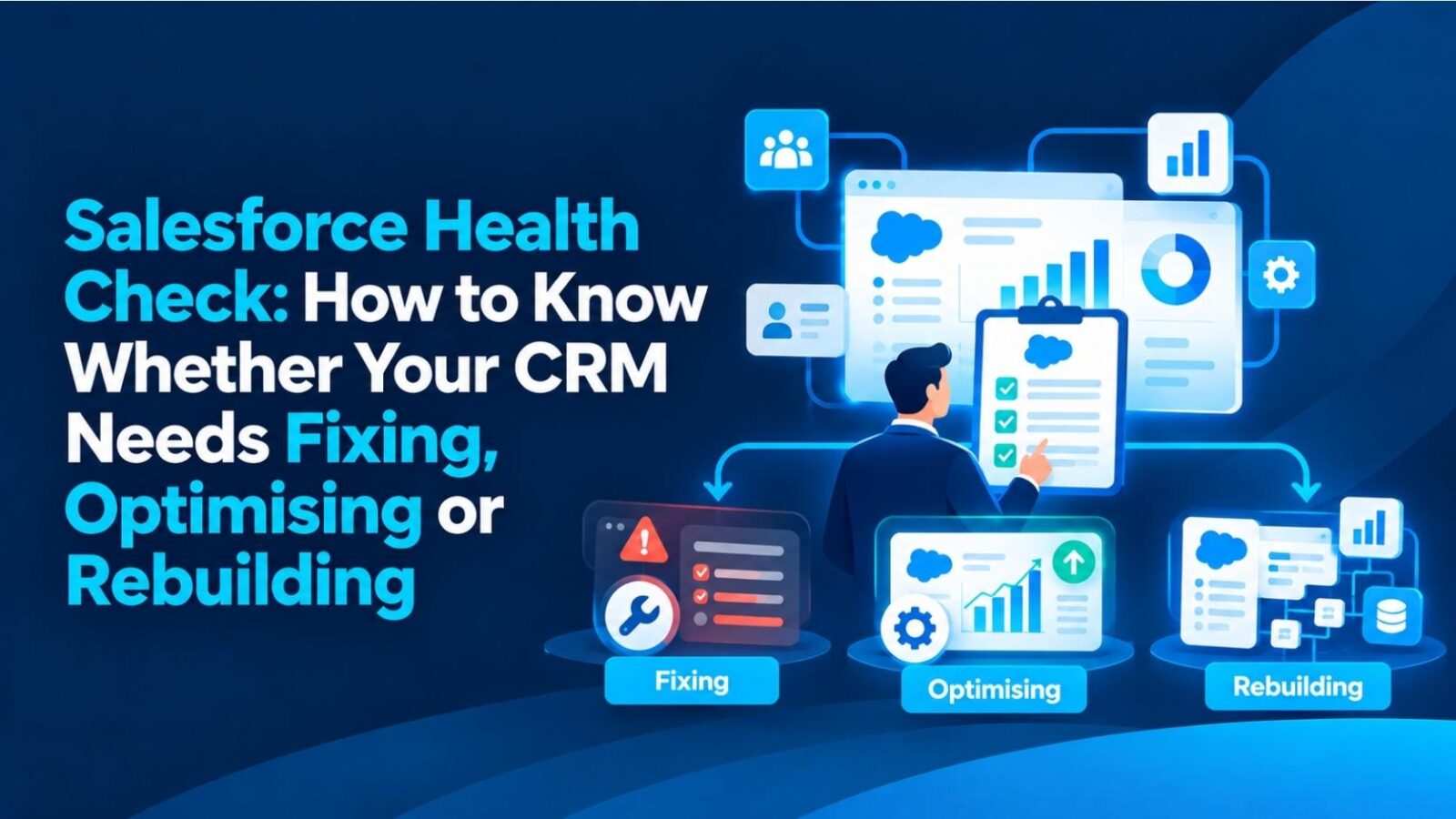
A Salesforce health check should tell you whether the problems in your CRM can be resolved with targeted fixes, require broader optimisation or are fundamental enough to justify rebuilding part or all of the solution. The answer depends on the condition of your data, automation, integrations, processes, reporting and architecture, and, crucially, whether Salesforce still reflects how your organisation actually operates.
At Sweet Potato Tec, our Salesforce health checks and audits are designed to identify issues across data, automation and structure. We have also been rescuing struggling Salesforce projects since 2014.
The important point is that a health check should diagnose before it prescribes.
An unreliable dashboard does not necessarily mean Salesforce needs rebuilding. Low adoption does not automatically mean users need more training. And a complicated Salesforce org does not necessarily need replacing.
First establish what is wrong and why. Then decide how much intervention is actually justified.
Key takeaway: does your Salesforce CRM need fixing, optimising or rebuilding?
If the underlying Salesforce design still supports the business and the problems are isolated, targeted fixes may be enough. If problems span processes, data, automation, reporting or adoption but the foundations remain sound, wider optimisation may be appropriate. Rebuilding should be considered when fundamental architecture or design decisions prevent Salesforce from supporting current business requirements and correcting them incrementally would create greater complexity.
A Salesforce health check provides the evidence needed to make that distinction.
What is a Salesforce health check?
A Salesforce health check is a structured assessment of how well the existing CRM supports the organisation’s current processes, users, data and objectives.
It should go further than checking whether Salesforce is technically functioning.
A system can be operational and still perform poorly as a CRM. Users may be able to log in and update records while management cannot trust the reports. Automations may run successfully but support a process that the business no longer uses. Integrations may technically transfer data while creating duplication or inconsistencies elsewhere.
Sweet Potato Tec’s Salesforce consulting services specifically include health checks and audits covering data, automation and structure, alongside process redesign and optimisation, reporting and forecasting improvement, and transformation roadmaps.
SPT’s existing Salesforce audit framework also looks at the CRM in layers, including opportunity and revenue structure, finance and operational integrations, automation and workflow processes, data quality and the wider governance needed to support Salesforce as an organisation grows.
That wider view matters because Salesforce problems rarely exist entirely in isolation.
What are the warning signs that Salesforce needs a health check?
A Salesforce health check is worth considering when the organisation can see persistent symptoms but does not have a clear view of their underlying causes.
Some of the clearest warning signs are low adoption, unreliable reporting and forecasting, processes that no longer reflect how teams work, growing dependence on spreadsheets, recurring data issues and a lack of a clear Salesforce roadmap.
These are also problems Sweet Potato Tec identifies in its Salesforce consulting work.
There are other warning signs that may be less obvious. A simple change may take much longer than expected because of dependencies elsewhere in Salesforce. Teams may maintain their own versions of customer or revenue data. Automations may overlap. Staff may enter information differently because fields and processes are poorly understood. An integration may regularly require manual correction.
The question to ask is not simply, “Is Salesforce broken?”
Ask instead: Where is Salesforce creating friction, unreliable information or unnecessary manual work?
That provides a much better starting point for a health check.
What should a Salesforce health check assess?
A useful Salesforce health check should assess both the technical environment and the business processes it is supposed to support.
At Sweet Potato Tec, the areas we examine can include data, automation and structure, but those elements need to be understood in context.
Does Salesforce still reflect how the organisation works?
Business processes change.
New products are introduced. Teams expand. Responsibilities shift. Pricing and revenue models develop. New systems are connected. Reporting requirements change.
A Salesforce implementation designed several years ago may therefore still work exactly as originally configured while no longer being right for the organisation using it.
SPT’s Salesforce audit guidance starts by reviewing areas such as opportunity design, product and pricing models, revenue schedules and forecasting categories. The purpose is to establish whether Salesforce still represents the way revenue and business processes actually work.
This is an important distinction. If Salesforce is faithfully automating an outdated process, fixing individual fields or screens will not solve the underlying problem.
Can you trust the data in Salesforce?
Data quality should be tested because unreliable CRM data affects almost everything built on top of it.
Duplicate records, missing information, inconsistent field use and incorrect relationships can weaken reporting, automation and forecasting. They can also reduce user confidence, which can create a cycle in which people rely less on Salesforce and data quality deteriorates further.
Sweet Potato Tec’s work with Curinos demonstrates how specific data problems can affect CRM reliability. Incorrect Contacts had been linked to Opportunities during an initial migration, affecting reporting and data integrity. SPT introduced new processes and Salesforce Flows to improve reassociation and duplicate prevention.
That is a useful example of why diagnosis matters. A reporting problem can originate much earlier in the data lifecycle.
Is Salesforce automation helping or adding complexity?
Automation should reduce unnecessary manual work. It should not make ordinary processes harder to understand or maintain.
A health check should therefore review how Salesforce automation works, where different automations overlap and whether the current logic still serves the business requirement.
Sweet Potato Tec’s existing audit methodology specifically includes reviewing Flow logic, duplicate automations, approval complexity and manual tasks that could be automated.
If one Flow is malfunctioning, that may be a targeted fix.
If years of overlapping automation have made routine changes risky and difficult to understand, the issue is broader. The organisation may need systematic optimisation.
The scale and interconnectedness of the problem help determine the appropriate response.
Are integrations moving the right data reliably?
Salesforce rarely operates alone.
Finance, marketing, operational and other systems may all exchange information with the CRM. A health check should establish what those integrations do, which data is exchanged, where the source of truth sits and whether failures or inconsistencies are creating manual work.
Sweet Potato Tec’s Salesforce integration capability covers discovery, architecture, implementation and ongoing support across API-based, middleware and custom integrations.
The health check therefore needs to consider Salesforce as part of a wider technology ecosystem rather than auditing the CRM in isolation.
Can users get the information they need from Salesforce?
Reporting is one of the clearest tests of CRM health.
If management regularly exports data to spreadsheets before it can answer basic questions about pipeline, revenue or performance, the health check should establish why.
The dashboard itself may not be the problem.
Sweet Potato Tec’s Revenue Intelligence case study involved an organisation whose forecasting was spreadsheet-based and whose Salesforce records contained duplicated, missing and inconsistent information. SPT’s work combined data preparation and governance with Salesforce CRM Analytics and Einstein Discovery to create a 48-month predictive forecasting model.
The lesson for a health check is straightforward: reliable analytics depend on reliable foundations.
When does Salesforce only need fixing?
Salesforce may only need targeted fixes when the underlying architecture and business processes remain appropriate and the problems are contained.
Examples might include a specific automation behaving incorrectly, a report that needs restructuring, a permissions issue, a limited data-quality problem or a clearly defined integration fault.
The defining characteristic is scope.
If the organisation can identify a discrete problem, understand its dependencies and resolve it without redesigning wider processes, a targeted intervention may be appropriate.
Sweet Potato Tec’s Managed Services cover day-to-day Salesforce configuration and development tickets, data stewardship, reports and dashboards, alongside smaller projects such as new Flow automation, health checks and integration support.
That distinction is useful because not every Salesforce issue requires a transformation programme.
A good health check should be capable of recommending a small fix when a small fix is genuinely enough.
When does Salesforce need optimising?
Salesforce needs wider optimisation when the core platform remains viable but accumulated issues are preventing it from working efficiently for the organisation.
This is often where the symptoms appear across several areas at once.
Teams may be using Salesforce but finding the process cumbersome. Reporting may work but require manual correction. Automations may have accumulated over time. Data standards may be inconsistent. Integrations may function but create avoidable work. The organisation may have no clear roadmap for improving any of it.
In that situation, fixing tickets individually can address symptoms without improving the overall system.
Sweet Potato Tec describes its approach to fixing failing Salesforce projects as beginning with a deep dive into the existing environment, including configuration, data quality and workflows. From there, SPT streamlines processes, improves data and reporting, addresses adoption and provides ongoing support.
Optimisation is therefore about making the existing Salesforce environment work better as a whole.
It does not assume the original implementation has failed completely. It recognises that the CRM has reached a point where piecemeal fixes are no longer the most effective way forward.
When should you consider rebuilding Salesforce?
Rebuilding should be considered when fundamental parts of the existing Salesforce design no longer provide a sensible foundation for the organisation’s requirements.
That is a much higher threshold than simply finding technical debt or poor configuration.
A rebuild may become relevant where the underlying data model is fundamentally misaligned with the business, critical processes cannot be supported without extensive workarounds, architectural decisions make ordinary change disproportionately difficult, or the organisation’s operating model has changed so substantially that the original implementation no longer provides an appropriate foundation.
Even then, “rebuild” does not necessarily mean deleting everything and starting with an empty Salesforce org.
Different parts of an environment can be in different conditions. Some components may remain useful while a particular process or architectural layer requires substantial redesign.
This is why the health check needs to come before the recommendation.
Sweet Potato Tec’s work with CyberRisk Alliance provides a useful example of what substantial transformation can involve, although it should not be misrepresented as a rebuild of an existing Salesforce org. CRA’s previous platform suffered from poor adoption, limited data access, inconsistent forecasting and heavy spreadsheet dependence. SPT carried out discovery across multiple teams and designed a connected Salesforce ecosystem around the organisation’s real workflows and future requirements.
The resulting Salesforce environment connected sales, finance, fulfilment, events, marketing and customer success, with adoption increasing from around 20 users to almost the entire organisation.
The relevant lesson is that significant technology change should follow a clear understanding of how the organisation needs to work.
Does low Salesforce adoption mean you need to rebuild the CRM?
No. Low Salesforce adoption is a warning sign, not proof that the CRM needs rebuilding.
The first task is to understand why people are not using it.
Users may find Salesforce cumbersome. Processes may contain unnecessary steps. Data may be unreliable. Teams may not receive useful information in return for the data they are expected to enter. Or users may simply need better training and support.
Those causes require different responses.
The CyberRisk Alliance project provides relevant evidence here. Before the transformation, only around 20 users were using the previous platform and even those users struggled to enter meaningful information. Following process redesign, integrations, training and a Salesforce implementation built around real workflows, adoption expanded to almost the entire organisation.
That does not mean every adoption problem requires transformation.
It means adoption should be investigated as part of the wider health of the CRM rather than treated automatically as a training issue.
How do you decide between fixing, optimising and rebuilding Salesforce?
The decision should be based on the cause, scale and interconnectedness of the problems identified during the Salesforce health check.
A useful way to think about the distinction is:
Fix Salesforce when the problem is contained and the underlying design remains appropriate.
Optimise Salesforce when the foundations remain useful but multiple processes, automations, data practices or integrations need coordinated improvement.
Rebuild part or all of the solution when fundamental design or architectural decisions prevent Salesforce from supporting current business requirements and incremental changes would add further complexity rather than resolve it.
The decision also needs to account for business priorities.
Not every technical imperfection needs correcting immediately. A health check may identify dozens of potential improvements, but the resulting roadmap should distinguish between urgent risks, high-value changes and work that can reasonably wait.
The purpose is not to produce the longest possible list of Salesforce problems.
It is to identify which changes will make the greatest practical difference.
What should happen after a Salesforce health check?
A Salesforce health check should result in a prioritised plan rather than simply an audit document.
The organisation should understand what is wrong, why it matters, what should be addressed first and which issues are connected.
That may lead to a defined optimisation project. Smaller problems may move into ongoing support. More fundamental findings may require a larger redesign or implementation programme.
Sweet Potato Tec’s Managed Services are designed around this longer-term view. Alongside support and small projects, SPT provides Salesforce roadmapping, organisation strategy alignment, data and AI strategy and change management.
This is important because CRM health is not permanent.
Processes change. Data grows. Integrations evolve. Users develop new requirements. Salesforce releases new platform updates.
The objective after a health check should therefore be not only to correct today’s problems, but to establish how the Salesforce environment will be managed as the organisation continues to change.
FAQs
How often should you run a Salesforce health check?
There is no single interval that is right for every organisation. A health check is particularly useful when Salesforce performance or adoption begins to deteriorate, the business has changed significantly, major new capabilities are being considered or the organisation is preparing to scale. Regular platform reviews can also identify issues before they become more disruptive.
Is a Salesforce health check the same as a technical audit?
Not necessarily. A technical audit can form part of a health check, but a useful Salesforce health check should also consider processes, users, data, reporting, integrations and business objectives. Technically sound configuration can still be poorly aligned with the organisation using it.
Can a Salesforce health check improve reporting?
A health check can identify why reporting is unreliable or inefficient. The cause may sit within reports and dashboards, but it may also originate with data quality, inconsistent processes or disconnected systems. Those underlying issues need to be understood before reporting can be improved effectively.
Can you optimise Salesforce without replacing the existing implementation?
Yes. Many Salesforce environments can be improved without being completely rebuilt. Existing configuration, data structures, integrations and processes should be assessed individually so that useful components can be retained while problematic areas are corrected or redesigned.
What is Salesforce technical debt?
In practical terms, Salesforce technical debt is accumulated complexity that makes the environment harder to understand, maintain or change. It can develop through repeated short-term fixes, outdated automation, unnecessary customisation or poorly governed changes. Its presence does not automatically mean Salesforce needs rebuilding, but it should be assessed during a health check.
Can Sweet Potato Tec carry out a Salesforce health check?
Yes. Sweet Potato Tec’s Salesforce consulting services include Salesforce health checks and audits designed to identify issues across data, automation and structure. Health checks are also included within Sweet Potato Tec’s Managed Services small-project capability.
Find out what your Salesforce CRM actually needs
If Salesforce is not working as well as it should, the answer is not automatically more development.
First establish what is causing the problem.
A Salesforce health check can identify whether the issue is isolated or systemic, whether the existing foundations remain suitable and whether the right response is a targeted fix, coordinated optimisation or more substantial redesign.
At Sweet Potato Tec, we assess Salesforce in the context of the organisation using it. That means looking at the CRM itself, but also at the processes, data, integrations, reporting and people that determine whether Salesforce actually delivers value.
Our Salesforce consultants provide health checks and audits, process redesign, reporting improvement and transformation planning, while our Managed Services provide ongoing support, optimisation and strategic Salesforce roadmapping.
The purpose of a Salesforce health check should not be to justify more Salesforce work. It should give your organisation enough evidence to make the right decision about what needs changing, and what does not.