
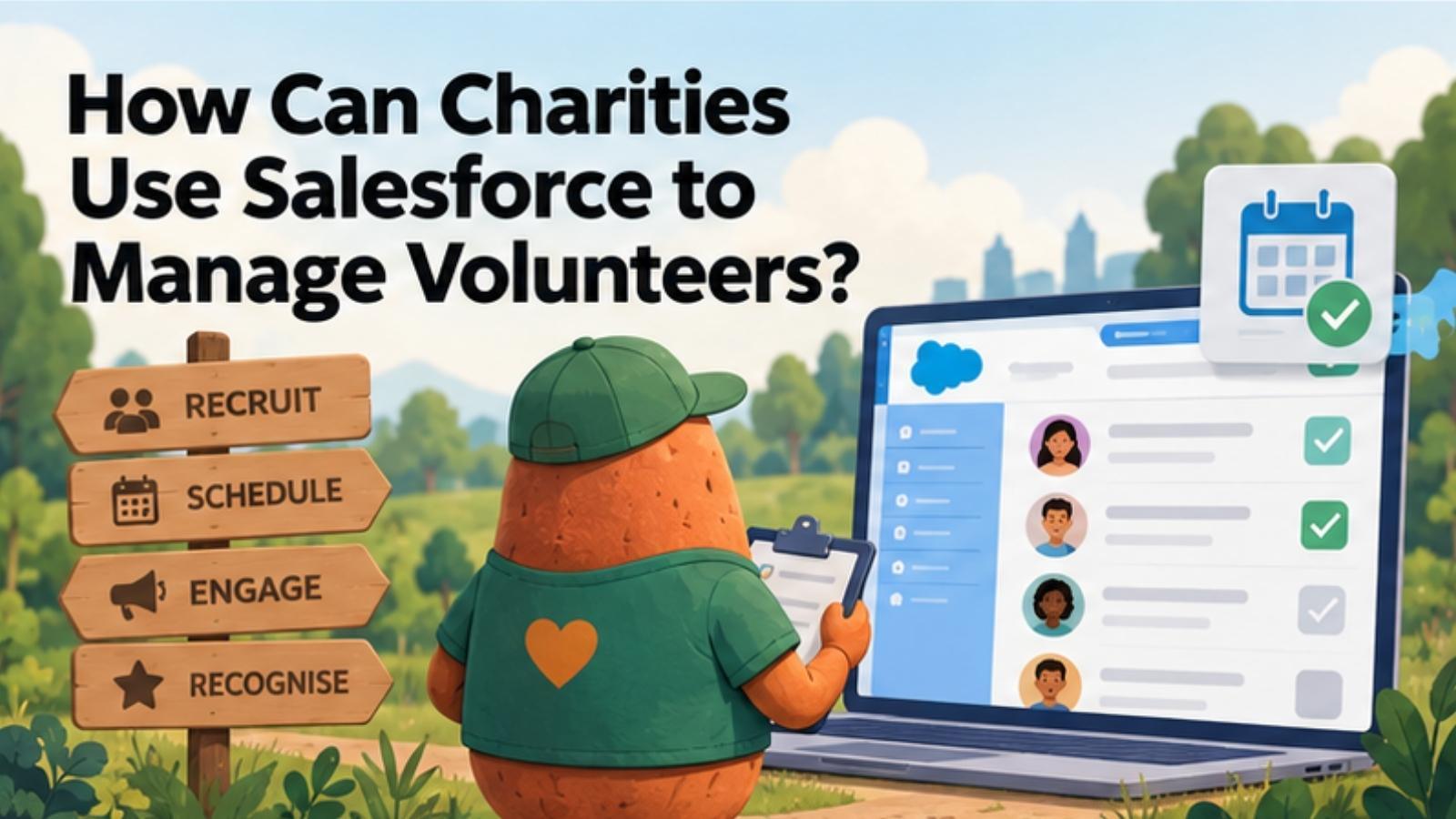
Salesforce can help charities manage the volunteer journey in one connected system, from initial enquiries and applications through onboarding, skills and availability, role matching, shifts, attendance, hours, communications and ongoing engagement.
The value is not simply replacing a volunteer spreadsheet with a CRM.
A well-designed Salesforce environment can connect volunteering with the wider relationship an individual has with the charity. Someone may be a volunteer, donor, event attendee, campaigner or supporter at different points in that relationship.
At Sweet Potato Tec, our Salesforce for Charities & Non-Profits work is designed around those real nonprofit operating models. Salesforce should reflect how your organisation recruits, coordinates and supports volunteers rather than forcing every charity into the same generic process.
Can Salesforce be used for volunteer management?
Yes. Salesforce Nonprofit Cloud can manage volunteer applications, activities, roles, shifts, attendance, skills, availability, hours and engagement history. Charities can use this information alongside wider supporter data, helping teams coordinate volunteers while building a more complete view of each relationship. The system still needs to be designed around the charity’s actual recruitment, safeguarding, onboarding and operational processes.
How can Salesforce manage volunteer enquiries and applications?
Salesforce can provide a structured route from someone’s initial interest in volunteering through to an application and subsequent volunteer record.
That creates an important distinction between someone expressing interest and someone becoming an active volunteer.
A charity may receive volunteer enquiries through its website, events, campaigns or direct contact. Without a connected process, those enquiries can end up in shared inboxes, spreadsheets or separate systems, making it difficult to understand where each prospective volunteer has reached.
Salesforce Nonprofit Cloud’s current Volunteer Management functionality includes applications management alongside volunteer activities, roles and shifts.
The application process can therefore become part of the CRM rather than an isolated administrative task.
For example, the organisation can design a process that reflects stages such as:
enquiry → application → review → checks → onboarding → active volunteer.
The precise stages should come from the charity.
At Sweet Potato Tec, we emphasise this because Salesforce for nonprofits only works well when the technology reflects how the organisation actually operates.
The objective is not to invent a new volunteer process because Salesforce has certain fields available.
It is to understand the process the charity needs and configure Salesforce around it.
Can Salesforce record volunteer skills, interests and availability?
Yes. Salesforce Nonprofit Cloud can record volunteer skills, availability, locations and engagement history so coordinators have more context when deciding where someone could contribute.
That is much more useful than simply maintaining a list of volunteer names.
Imagine a charity needs volunteers for several different roles.
One person may have specialist professional skills but only be available remotely. Another may be available every Tuesday and prefer direct service delivery. Someone else may be willing to help at occasional weekend events.
Those differences matter operationally.
Salesforce’s current Volunteer Management functionality allows organisations to capture availability, locations and skills, helping coordinators understand which volunteers may be appropriate for different activities.
Sweet Potato Tec’s Salesforce for Animal Charities proposition applies the same principle to volunteer and foster networks, including volunteer roles, hours and activity alongside foster-carer profiles and availability.
The practical benefit is visibility.
Instead of asking who might be available and then searching through emails or spreadsheets, coordinators can work from structured volunteer information.
How can Salesforce support volunteer vetting, safeguarding and background checks?
Salesforce can support the process around volunteer vetting and safeguarding by recording appropriate statuses, requirements, tasks and dates, but charities should not assume the CRM itself replaces the relevant checks or safeguarding procedures.
That distinction is particularly important for UK charities.
Some volunteer roles may require additional checks, training, references or approvals before the individual can begin. The exact requirements depend on the role and organisation.
A Salesforce process can be designed to help the charity understand where a volunteer is within that journey.
For example, an organisation may need visibility of whether required checks have been initiated or completed, whether mandatory training has been completed and whether someone is approved for a particular type of activity.
The system can also help prevent the operational problem of important requirements being tracked through individual inboxes or separate spreadsheets.
For charities delivering human services, this needs especially careful design.
Our Salesforce for Human Services Charities work recognises the importance of safeguarding-aware processes, secure data, clear audit trails and role-based access in organisations handling sensitive service information.
The CRM should support the charity’s safeguarding process.
It should not define that process on the charity’s behalf.
How can Salesforce improve volunteer onboarding and training?
Salesforce can provide a structured onboarding process so that coordinators can see what needs to happen before a new volunteer becomes fully active.
The exact onboarding journey varies between organisations.
It may include an induction, training, documentation, role-specific preparation or other requirements established by the charity.
Rather than managing each step informally, Salesforce can provide a consistent record of progress.
Automation can also support appropriate administrative tasks and reminders.
The key is not to automate everything.
A volunteer’s first experience of an organisation is part of the relationship. Personal communication may be far more appropriate at some points than an automated message.
Salesforce should remove repetitive administration so that staff have more time for the interactions that benefit from a person.
For example, the system might help identify which onboarding actions remain incomplete without replacing the conversation a volunteer coordinator needs to have with the individual.
This balance between automation and human engagement is particularly important for charities.
Efficiency matters, but volunteering is still a relationship between a person and an organisation.
Can Salesforce match volunteers with suitable roles?
Yes. Information about a volunteer’s skills, availability and location can help charities identify appropriate roles and activities.
Salesforce’s current Nonprofit Cloud Volunteer Management functionality is designed to capture those attributes alongside volunteer opportunities.
For coordinators, this can improve matching.
Rather than asking only, “Who is on our volunteer list?”, the organisation can ask more useful questions:
Who is available?
Who has the required skills?
Where are they based?
Which roles have they previously completed?
What are they interested in?
Which activities need additional capacity?
Salesforce also supports the underlying structure required to organise volunteer activities, roles, shifts and locations.
That creates a connection between what the charity needs and what the volunteer can offer.
The technology still needs sensible processes behind it.
Skills need to be recorded consistently. Availability needs to remain current. Roles need clear requirements.
A CRM cannot compensate for unclear volunteer roles.
But when the process is defined properly, connected data can make coordination considerably easier.
Can Salesforce manage volunteer shifts, events and activities?
Yes. Salesforce Nonprofit Cloud Volunteer Management can be used to create volunteer activities, roles, shifts and locations, plan capacity, assign volunteers and record attendance.
This is particularly useful for organisations coordinating large numbers of people across different activities.
An events charity might need volunteers across several venues and time slots.
An animal charity may need to coordinate volunteer and foster networks.
A community organisation may have regular activities alongside one-off events.
Salesforce can provide a shared operational view rather than requiring each coordinator to maintain a separate schedule.
Sweet Potato Tec’s nonprofit Salesforce services explicitly include organising volunteer schedules and activities alongside tracking roles, hours and engagement.
For animal welfare organisations, our Salesforce for Animal Charities work also focuses on coordinating volunteer and foster networks with less administration and better visibility.
The appropriate configuration depends on the organisation.
A small charity running occasional volunteer days does not need the same scheduling architecture as a national organisation coordinating several programmes and locations.
Salesforce should be proportionate to the problem.
How can charities record volunteer attendance and hours in Salesforce?
Salesforce can record volunteer attendance and hours so charities can understand participation at both individual and organisational level.
Salesforce’s current volunteer-management functionality includes attendance tracking, check-in and check-out information and volunteer activity history.
That creates several useful possibilities.
A coordinator can see whether someone attended a scheduled activity.
The charity can understand how many hours an individual has contributed.
Teams can examine volunteering activity over time.
And volunteer contribution can become part of wider reporting rather than remaining in a separate spreadsheet.
Sweet Potato Tec’s nonprofit proposition specifically includes tracking volunteer hours, roles and engagement.
For animal charities, we also identify volunteer hours and activity tracking as part of a connected donor, volunteer and foster-network CRM.
But collecting information should have a purpose.
If nobody uses a particular volunteering metric, requiring staff or volunteers to maintain it simply creates administration.
Before configuring Salesforce, ask what information is genuinely needed for coordination, recognition, reporting and impact measurement.
Then design the process around those requirements.
How can Salesforce improve volunteer communications and retention?
Salesforce can improve volunteer communication by giving teams better information about who volunteers are, how they engage and where they are in their relationship with the charity.
That makes communication more relevant.
A new applicant may need different information from a long-standing volunteer.
Someone who regularly supports one type of activity should not necessarily receive the same operational communications as someone involved elsewhere.
Salesforce Nonprofit Cloud can maintain volunteer engagement history alongside skills, availability and activity.
Sweet Potato Tec’s Salesforce for Charities & Non-Profits proposition specifically includes improving volunteer communication and retention.
However, retention should not be treated as a matter of sending more automated emails.
The data can help a charity notice patterns.
Has a previously active volunteer stopped attending?
Are certain opportunities repeatedly difficult to fill?
Are volunteers registering interest but not progressing through onboarding?
Do people engage heavily with one type of activity but not another?
Those questions can help volunteer teams investigate what is happening.
Salesforce provides the information.
The charity still needs to understand the people behind it.
How can Salesforce connect volunteering with the wider supporter relationship?
Salesforce can connect volunteering with other relationships an individual has with the charity, creating a more complete supporter view.
This is one of the most important reasons to consider volunteer management within the wider CRM.
A person does not necessarily fit neatly into one category.
Someone might first encounter the charity through an event.
They may later volunteer.
They may also donate.
They might participate in a campaign, refer someone to a service or become a regular supporter.
If fundraising, volunteering, events and communications all maintain separate records for that individual, the charity sees fragments of the relationship.
Salesforce Nonprofit Cloud is designed to bring volunteer information together with fundraising and programme data.
For Sweet Potato Tec, this is central to the way we approach Salesforce for nonprofit organisations.
The aim is not merely to centralise data.
It is to make the relationship understandable.
That can help prevent inappropriate or duplicated communication, improve segmentation and give teams a clearer picture of how people support the organisation.
The quality of that view still depends on data governance and identity matching.
Putting several databases into Salesforce without resolving duplicates does not automatically create a single supporter view.
But a properly designed CRM provides the foundation on which that connected relationship can be built.
How can charities measure volunteer contribution and impact?
Salesforce can help charities report on volunteer activity by bringing information such as roles, attendance, hours and engagement into structured records that can be analysed over time.
That can provide useful evidence for operational teams, leadership, trustees and other stakeholders.
However, volunteer activity and volunteer impact are not automatically the same thing.
Recording that 100 hours were volunteered tells the organisation something important about contribution.
It does not necessarily explain what those 100 hours achieved.
To understand impact, the charity first needs to define the outcome it is trying to measure.
The CRM can then help connect the relevant activity and outcome information where the data model supports it.
Salesforce Nonprofit Cloud combines volunteer management with wider programme and outcome-management capabilities, making it possible to consider volunteering within a broader organisational reporting model.
Sweet Potato Tec’s nonprofit work also includes impact reporting and insight, including dashboards, outcome tracking and visibility across programmes and services.
The reporting should still begin with a question.
What does the volunteer team need to know?
What does leadership need?
What do trustees or funders need?
What would help the organisation improve the volunteer experience?
Collect the information that answers those questions rather than measuring everything simply because the CRM can store it.
What should a charity decide before implementing volunteer management in Salesforce?
Define your volunteer process before configuring the technology.
Map what actually happens from first contact onwards.
How does someone express interest?
What information is collected?
Is there an application?
Who reviews it?
Which checks or approvals are required?
What onboarding or training takes place?
How are people matched to roles?
How is availability maintained?
How are shifts or activities organised?
How is attendance recorded?
Who communicates with volunteers?
What happens when someone stops engaging?
Which information needs to be reported?
And how should volunteering connect with the individual’s wider supporter record?
These questions expose the actual Salesforce requirement.
At Sweet Potato Tec, our Salesforce implementation work begins with stakeholder workshops, systems, data, processes and business goals before moving into solution design.
That approach is particularly important for volunteer management because processes can differ enormously between charities.
Do not start with a generic volunteer database and try to make the organisation fit around it.
Start with how your volunteers actually interact with the charity.
Then build the Salesforce process around that journey.
FAQs
Can volunteers apply through Salesforce?
Salesforce Nonprofit Cloud supports volunteer applications, and Experience Cloud can provide self-service experiences for volunteer opportunities and sign-up. The exact application journey should be configured around the charity’s requirements.
Can Salesforce track volunteer skills and availability?
Yes. Salesforce’s current Volunteer Management functionality can capture skills, availability and location alongside engagement history. This can help coordinators identify people who may be suitable for particular roles or activities.
Can Salesforce manage DBS checks for volunteers?
Salesforce can support the administrative workflow around checks by recording appropriate statuses, dates, requirements and follow-up tasks where correctly designed. It should not be treated as the authority conducting a DBS check or as a replacement for the charity’s safeguarding procedures. The organisation should determine what information it is appropriate and lawful to record.
Can volunteers manage their own information in Salesforce?
Salesforce can use Experience Cloud to provide volunteer self-service experiences, including opportunities and sign-up. The appropriate level of self-service depends on the charity’s processes, security requirements and Salesforce configuration.
Is Salesforce suitable for a charity with only a small number of volunteers?
Potentially, but the decision should be proportionate. A small charity with a simple process may not need an extensive volunteer-management implementation. Salesforce becomes particularly valuable where volunteer information needs to connect with fundraising, programmes, events or other supporter relationships, or where spreadsheets and manual administration are creating operational problems.
Can Salesforce help a charity retain more volunteers?
Salesforce can provide the information needed to understand engagement, activity and changes in participation, and can support more relevant communication and follow-up. It cannot guarantee retention. Charities still need to understand why volunteers engage or disengage and address the underlying experience rather than treating retention as a CRM metric alone.
Build Salesforce around the volunteer journey
Volunteer management is not simply a scheduling problem.
It begins when someone first expresses an interest and continues through application, checks, onboarding, training, role matching, participation, communication and ongoing engagement.
Salesforce can connect those stages.
More importantly, it can connect volunteering with the wider relationship that person has with your charity.
At Sweet Potato Tec, our Salesforce for Charities & Non-Profits work includes volunteer and community engagement alongside fundraising, supporter management and impact reporting.
For organisations with more specialised operating models, we also design Salesforce around the realities of sectors such as animal welfare and human services, where volunteer coordination may sit alongside foster networks, service delivery, safeguarding-aware processes and sensitive information.
The technology should follow the organisation.
Define the volunteer journey first. Decide what information genuinely needs to be captured. Establish how volunteering connects with the wider supporter relationship. Then configure Salesforce to make those processes easier to manage.
That is how a volunteer CRM becomes more than a database.
It becomes a connected view of the people giving their time to your mission.