
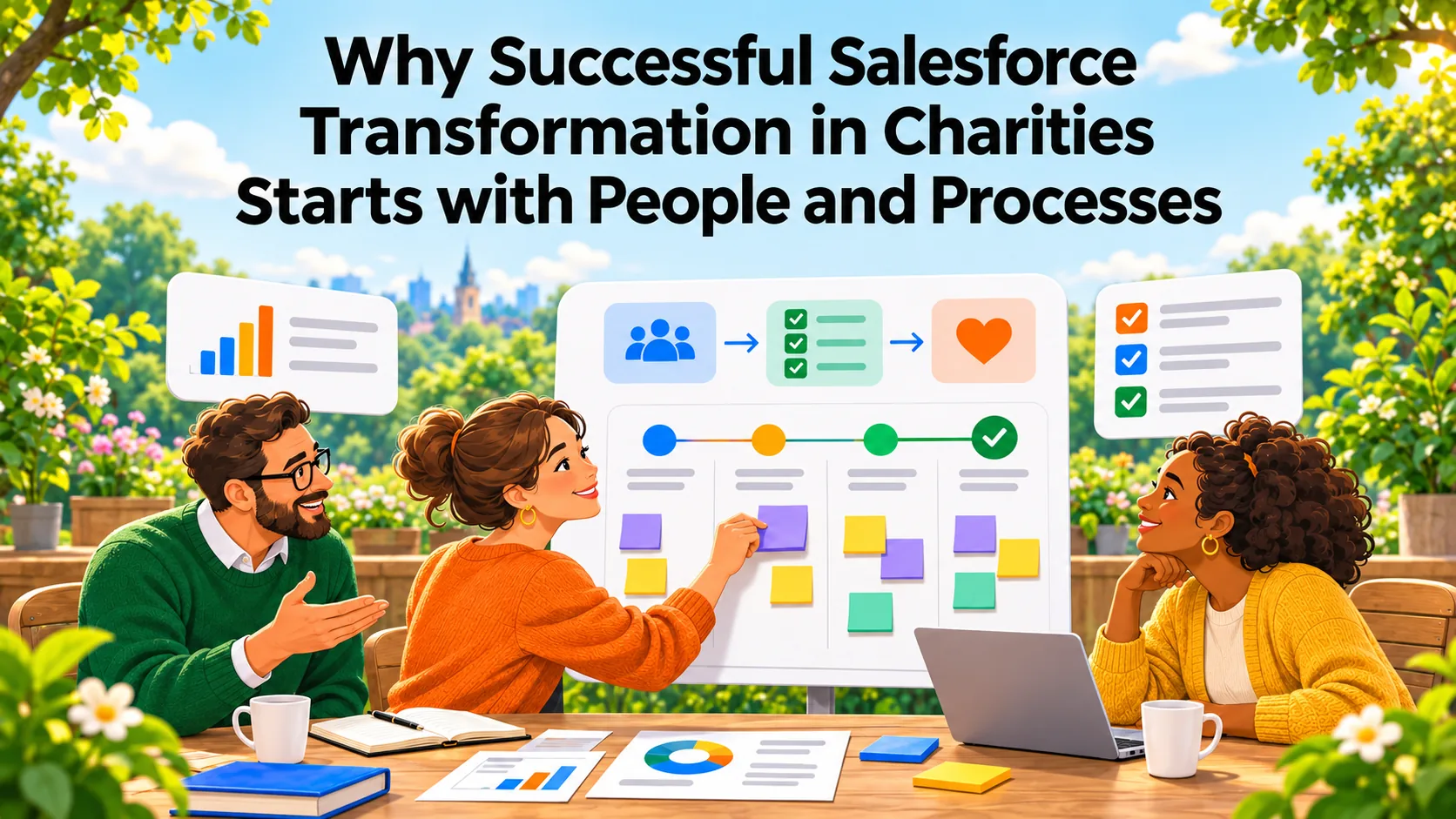
A Salesforce implementation can be technically sound and still fail to deliver the improvement a charity expected. The deciding factor is often whether the organisation has prepared its people, processes and operating model for the change.
When a charity invests in Salesforce, it is understandable that much of the early conversation focuses on technology. Teams discuss products, integrations, data migration, automation and reporting. These are important decisions, but they do not determine success on their own.
A system only creates value when people use it consistently, processes support it and leaders make clear decisions about ownership. If those foundations are missing, the technology can go live while the wider transformation quietly stalls around it.
This is why Sweet Potato Tec approaches Salesforce transformation as an organisational change programme rather than a software installation. The technical work matters, but it needs to sit alongside governance, operational design, training, communication and ongoing support.
Why technically successful projects can still disappoint
A project team may complete the configuration, migrate the agreed data and launch the platform on time. Yet employees may continue using spreadsheets, managers may distrust reports and important processes may still depend on manual workarounds.
That does not necessarily mean Salesforce was the wrong choice. It may mean the organisation did not resolve the operational questions that sit around it.
- Who owns each process once the implementation team steps away?
- Which decisions can employees make, and which need approval?
- Have teams agreed a consistent way of recording information?
- Do employees understand why their work is changing, not simply which buttons to press?
- Is there enough capacity to support users and improve the system after launch?
- Are leaders measuring adoption and organisational outcomes, rather than only technical delivery?
If these questions remain unanswered, even a well-built platform can struggle to become part of everyday work.
Change begins with the outcome
The starting point should be the improvement the charity wants to achieve. That might be giving fundraisers more time with supporters, improving the visibility of services, reducing duplicate records, making volunteer coordination safer or providing trustees with more reliable information.
Once the outcome is clear, the organisation can work backwards. Which processes need to change? Which teams are involved? What information do they need? Where are responsibilities unclear? What should Salesforce enable, and what is better addressed through policy, training or simpler operational changes?
This avoids a common problem: recreating the existing process inside a new system without questioning whether that process works well in the first place.
Five areas that need to move together
Programme governance and accountability
A transformation needs visible sponsorship and clear ownership. Leaders should know who can make decisions, how risks are escalated and how progress will be measured. Teams also need to understand who will own Salesforce, its data and its connected processes after go-live.
Operating model and structure
Salesforce often crosses departmental boundaries. Fundraising, finance, service delivery, volunteering, events and leadership may all rely on the same information. The project therefore needs to consider how those teams work together, where handovers occur and which version of the information is authoritative.
Processes and ways of working
Technology can automate an agreed process; it cannot resolve a process nobody has agreed. Before configuration begins, the charity should identify unnecessary steps, inconsistent approaches and work that exists only because the current system is difficult to use.
Capability and confidence
Training should reflect what different employees actually need to do. A fundraiser, Salesforce administrator, service manager and trustee will not need the same knowledge. Role-specific training, practical guidance and accessible support help people build confidence without overwhelming them.
Adoption and performance
Go-live is the beginning of adoption, not the end. The charity should monitor how the platform is being used, listen to employee feedback and identify where processes are still breaking down. Improvements can then be prioritised according to their operational value.
Bringing operational change and technology together
Sweet Potato Tec combines Salesforce, data and integration expertise with Change Enablement for Non-Profits. This brings the technical solution together with the leadership, processes, communication, training and adoption support the organisation needs to make the change work in practice.
The aim is not to add another layer of theory. It is to make the change workable in practice: clarifying accountabilities, preparing teams, strengthening processes and making sure the technology supports the mission rather than becoming another obstacle.
This approach is particularly valuable when a programme is already under pressure. A charity may not need to start again. It may need an independent view of what is blocking progress, followed by a practical plan that addresses people, processes, data and technology together.
What should charity leaders ask before approving a project
- What organisational outcome are we trying to achieve?
- Which teams and processes will need to change?
- Who owns the decisions, the data and the platform?
- How will employees be involved before configuration is finalised?
- What training and support will different users need?
- How will we know whether the change has been adopted?
- What happens after the initial implementation is complete?
A credible Salesforce partner should be comfortable discussing all of these questions. If the conversation begins and ends with configuration, an important part of the transformation may be missing.
Change that lasts
Charities do not invest in Salesforce because they want a new database. They invest because they want to work more effectively, understand their supporters and services more clearly, and create more capacity for their mission.
Achieving that requires good technology. It also requires clear leadership, workable processes, confident people and a plan for continuous improvement. When those elements move together, Salesforce becomes part of a stronger organisation rather than a standalone IT project.
Through Change Enablement for Non-Profits, Sweet Potato Tec helps charities plan, implement and improve Salesforce with the organisational outcome kept firmly in view. If your programme is being planned, has lost momentum or is live without delivering the expected value, we can help identify what needs to change next.