
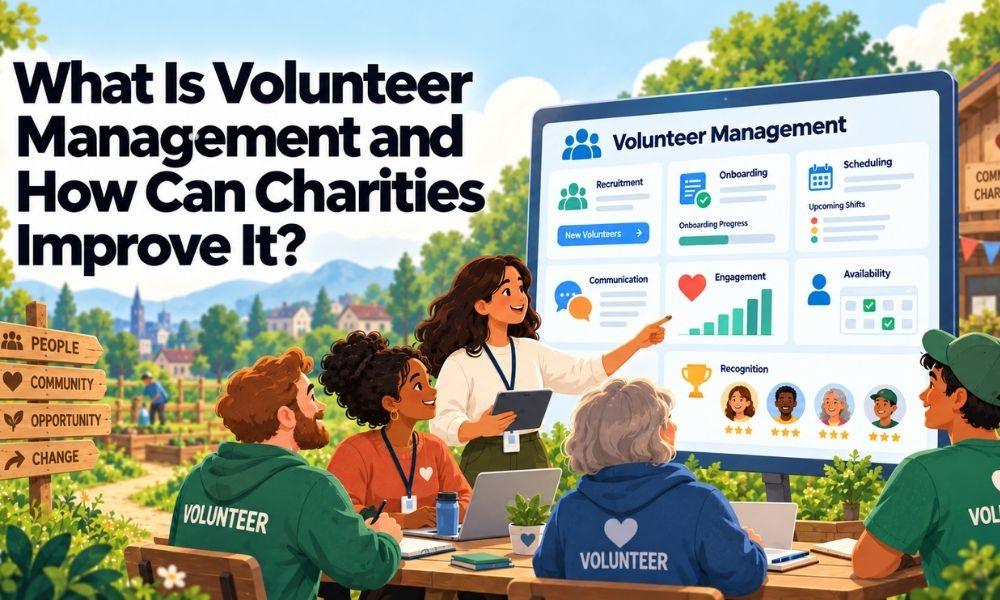
Good volunteer management is not simply about finding enough people to fill a rota.
It covers the complete relationship between a charity and the people giving their time to support it.
That begins before someone formally becomes a volunteer. It includes recruitment, applications, appropriate checks, onboarding, training, role matching, communication, scheduling, recognition and ongoing engagement. It also includes what happens when someone’s circumstances change or they decide to stop volunteering.
When these processes work well, volunteers know what is expected of them, staff have the information they need and the organisation can make better use of the time and skills people are offering.
When they do not, even committed volunteers can become frustrated.
At Sweet Potato Tec, our work with charities and non-profits often involves organisations trying to reduce manual administration and disconnected information. Technology can help, but improving volunteer management starts with the volunteer experience and the organisation’s processes.
What is volunteer management?
Volunteer management is the process of recruiting, onboarding, supporting, coordinating and retaining people who give their time to an organisation. Effective volunteer management connects clear roles, appropriate checks and training, skills and availability, communication, scheduling, recognition and feedback. Technology can support those processes, but charities first need to define a volunteer experience that works for both volunteers and the organisation.
What makes volunteer management effective?
Effective volunteer management gives people clarity throughout their relationship with the charity.
A prospective volunteer should understand what opportunities exist.
An applicant should know what happens next.
A new volunteer should understand their role.
An active volunteer should know when and where they are needed.
Staff should be able to see relevant availability, training and participation information.
And someone who has given their time should feel that contribution has been recognised.
The details will vary enormously between organisations.
A national charity coordinating thousands of volunteers needs a different operating model from a small local organisation running occasional community activities.
An animal charity coordinating foster carers has requirements that differ from a fundraising charity using volunteers mainly for events.
The aim is not to create the most sophisticated volunteer-management process possible.
It is to make the process clear, proportionate and manageable.
How can charities improve volunteer recruitment?
Start with clearly defined roles rather than recruiting volunteers first and deciding what to do with them later.
A useful volunteer role should explain what the charity needs, what the person will be doing and what commitment is expected.
Consider:
What will the volunteer actually do?
Where will they do it?
How frequently are they needed?
Are there particular skills or experience required?
Is training provided?
Are there eligibility or checking requirements?
Who will support them?
What should they expect from the organisation?
Clear roles help potential volunteers decide whether an opportunity is appropriate before applying.
They also improve the charity’s ability to recruit for genuine operational needs.
A common mistake is treating “we need more volunteers” as the requirement.
The more useful question is:
What work do we need volunteers to support, and what type of person, availability or skills would make that work successful?
That creates a much stronger basis for recruitment and later role matching.
How should charities manage volunteer applications?
Applications should collect the information genuinely needed to determine whether someone is suitable for the opportunity and what needs to happen next.
The process should be proportionate to the role.
Not every volunteer opportunity requires the same application journey.
A short-term event volunteer may have very different requirements from someone undertaking regular work involving vulnerable people or significant responsibilities.
The charity should therefore define:
what information it needs,
why it needs it,
who reviews the application,
what happens after submission,
whether an interview or conversation is required,
what checks apply,
and how applicants are kept informed.
Long periods of silence can create a poor first impression.
Even if the process cannot be completed immediately, clear communication about the next stage can make the experience easier to understand.
The objective is not simply to process an application.
It is to begin the volunteer relationship well.
How should vetting, safeguarding and compliance fit into volunteer management?
Any required checks should be built into the volunteer process rather than managed informally through inboxes, memory or disconnected notes.
The exact requirements depend on the organisation, the role and the people or services involved.
For some roles, the charity may need to consider references, safeguarding requirements, DBS checks, training, qualifications or other approvals.
Those requirements should be determined by the charity using the appropriate current guidance.
A volunteer-management process can then make it clear:
which checks apply to which roles,
whether they have been initiated,
whether they have been completed,
whether further action is required,
and whether the person is approved to begin a particular activity.
This is both an operational and information-governance issue.
Charities should consider carefully what personal information needs to be recorded, who should have access to it and how long it should be retained.
A CRM or volunteer-management platform can help administer the process.
It does not decide what safeguarding or compliance requirements apply.
Why does volunteer onboarding matter?
Onboarding turns an approved applicant into someone who understands how to contribute effectively.
Recruitment gets someone through the door.
Onboarding helps them understand what happens once they arrive.
Depending on the role, that might include:
an introduction to the charity,
role-specific guidance,
policies and procedures,
training,
health and safety information,
safeguarding information,
practical instructions,
introductions to staff,
and details about who to contact for help.
Good onboarding should answer the questions a new volunteer is likely to have.
What am I supposed to do?
Who am I working with?
Where do I need to be?
What happens if I cannot attend?
Who can I ask if I am unsure?
What does good performance in this role look like?
Do not assume that someone who is willing to volunteer automatically knows how the organisation operates.
Clear onboarding can reduce confusion for both volunteers and the staff supporting them.
How can charities match volunteers with the right roles?
Use skills, interests, experience and availability rather than simply allocating people wherever there is an empty space.
Someone may be enthusiastic about the charity without being suited to every opportunity it offers.
A person with professional skills may want to use those skills.
Another may deliberately want to do something completely different from their day job.
Some people prefer direct service delivery.
Others may enjoy fundraising, events, administration or practical work.
Availability matters too.
A perfect role that takes place when the volunteer is never free is not a useful match.
Charities should therefore understand:
skills,
interests,
preferred activities,
location,
availability,
experience,
and any role-specific requirements.
Matching does not need to become an elaborate scoring exercise.
It simply needs enough information to avoid treating volunteers as interchangeable.
The better the organisation understands what a volunteer can and wants to contribute, the easier it becomes to identify suitable opportunities.
How should charities manage volunteer availability and scheduling?
Volunteer scheduling should give both staff and volunteers a clear view of what has been agreed.
Spreadsheets can work for small and simple arrangements.
Problems begin when several people maintain different versions, schedules change frequently or volunteers are coordinating across multiple roles, events or locations.
A useful scheduling process should make it easy to understand:
which activities need volunteers,
how many people are required,
which skills or roles are needed,
who has agreed to attend,
where the activity takes place,
when it starts and finishes,
and what happens if somebody becomes unavailable.
Communication is part of scheduling.
A volunteer should not need to search through an old email chain to work out whether they are expected somewhere tomorrow.
Likewise, coordinators need to know when a gap has appeared early enough to respond.
The aim is reliability without unnecessary administration.
How can charities communicate better with volunteers?
Volunteer communication should be timely, relevant and proportionate.
More communication is not automatically better communication.
Volunteers need the information required to participate confidently without being overwhelmed by messages that have little relevance to them.
Consider the different stages of the relationship.
An applicant may need confirmation and information about what happens next.
A new volunteer may need onboarding material.
Someone scheduled for an activity may need practical instructions and a reminder.
An established volunteer may need information about new opportunities.
Someone who has not participated recently may benefit from a personal check-in rather than another generic newsletter.
The organisation should also make it clear how volunteers can communicate back.
Where do they ask questions?
How do they report that they cannot attend?
Who should they speak to about a problem?
How can they give feedback?
Communication should work in both directions.
This becomes harder when contact information and engagement history are spread across spreadsheets, inboxes and individual staff members.
That is one of the points at which better systems can begin to support a better volunteer experience.
What makes volunteers stay engaged?
Volunteer engagement depends on more than filling shifts.
People are more likely to remain meaningfully involved when they understand their role, feel supported and can see that their contribution matters.
Charities should pay attention to:
whether expectations are clear,
whether volunteers receive the information they need,
whether roles use their time effectively,
whether they can raise concerns,
whether their contribution is recognised,
whether there are suitable opportunities to remain involved,
and whether the organisation acts on useful feedback.
Recognition does not need to mean elaborate reward programmes.
A genuine thank you can matter.
So can showing volunteers what their contribution helped the organisation achieve.
If someone has given dozens of hours to support a programme, explaining the difference that work made can connect the task with the wider mission.
Sweet Potato Tec’s Salesforce for Charities & Non-Profits proposition includes improving volunteer communication and retention and recognising volunteer contributions effectively.
The technology can support that.
The organisation still has to create the relationship.
Why do volunteers disengage?
There is rarely one universal reason, so charities should avoid assuming that inactivity means a volunteer has lost interest.
People’s circumstances change.
Work becomes busier.
Family commitments shift.
The available roles may no longer suit them.
They may have had a poor experience.
Communication may have stopped.
They may not feel useful.
Or they may simply need a break.
This is why disengagement should be understood rather than treated only as a number.
If previously active volunteers stop participating, look for patterns.
Is there a particular stage where applicants disappear?
Do people complete onboarding but never take a shift?
Are some roles experiencing much higher turnover?
Are volunteers repeatedly cancelling because the timing is unsuitable?
Do certain teams retain volunteers more effectively than others?
Quantitative information can reveal where to investigate.
Conversations and feedback help explain why it is happening.
That combination is far more useful than simply counting how many volunteers remain on a database.
How should charities recognise volunteer contributions?
Recognition should make volunteers feel that the organisation notices and values the time they give.
This can happen in different ways.
A personal thank you may be appropriate.
Some charities may celebrate milestones or length of service.
Others may share the outcome of a project or event volunteers supported.
The important part is authenticity.
Recognition should not become another automated process performed because a CRM says someone reached a particular number of hours.
Data can help identify contributions.
People still need to make the appreciation meaningful.
Volunteer records can also help organisations avoid overlooking people whose contribution is less visible.
Someone volunteering remotely or supporting administrative work may not be as publicly visible as someone at a major event, but their contribution can be just as important to the organisation.
A consistent approach helps charities recognise the full range of support they receive.
How can charities measure volunteer satisfaction, retention and impact?
Start by separating participation from experience and impact.
Volunteer hours tell you how much time people contributed.
Attendance tells you whether scheduled activities were filled.
Retention can indicate whether people continue volunteering.
Those are useful measures.
They do not tell you everything.
A charity might also want to understand:
How satisfied are volunteers with their experience?
Do they feel properly prepared?
Would they recommend volunteering with the organisation?
Which roles have strong or weak retention?
At what stage do prospective volunteers drop out?
Are the right skills available when needed?
What outcomes are volunteers helping the charity achieve?
The final question is especially important.
Hours are an activity measure.
They are not automatically an impact measure.
If volunteers contributed 2,000 hours to a programme, the charity still needs to ask what those hours enabled the organisation to achieve.
The right measures depend on the charity’s objectives.
Do not collect dozens of volunteer metrics simply because they are available.
Measure what helps the organisation improve the experience, coordinate resources or demonstrate meaningful contribution.
When do spreadsheets stop being enough for volunteer management?
Spreadsheets become a problem when maintaining them begins to require more effort than the process they are supposed to support.
There is no particular number of volunteers at which a charity must move away from spreadsheets.
Look instead for operational warning signs.
Different teams maintain different volunteer lists.
Nobody is sure which version is current.
Availability is difficult to keep updated.
Applications are tracked through email.
Important checks or training are recorded separately.
Scheduling requires repeated manual messages.
Volunteer hours are difficult to calculate.
Communication history is not visible.
Reporting takes hours of manual consolidation.
Duplicate volunteer records are common.
Information disappears when a member of staff leaves.
These are signs that the issue is no longer the spreadsheet itself.
The organisation has outgrown a disconnected way of working.
Sweet Potato Tec says it regularly works with animal charities that have reached this point, where donor data, volunteer coordination and service activity have become spread across multiple tools and reporting has become difficult.
The next step should still be process review rather than immediately buying technology.
Understand what is failing first.
Then decide what kind of system would solve it.
What role can technology play in better volunteer management?
Technology can connect volunteer information and automate repetitive administration once the underlying processes are clear.
This is where a CRM such as Salesforce can become useful.
Current Salesforce Nonprofit Cloud volunteer functionality can support:
volunteer applications,
activities and roles,
shifts and locations,
capacity planning,
attendance,
skills,
availability,
engagement history,
hours,
reminders,
and volunteer self-service.
Sweet Potato Tec’s Salesforce for Charities & Non-Profits work similarly includes organising volunteer schedules and activities, tracking hours, roles and engagement, improving communication and retention and recognising contributions.
The important word is support.
Technology should support the volunteer-management model.
It should not become the model.
If roles are unclear, putting them into Salesforce will not make them clearer.
If onboarding is poor, automating it can simply deliver a poor experience more efficiently.
If nobody knows why volunteers are leaving, a dashboard will not provide the answer automatically.
Define the process first.
Then use technology to make it easier to operate consistently.
How can Salesforce support a connected volunteer relationship?
Salesforce can connect volunteering with the other relevant ways a person interacts with the charity.
This becomes valuable because volunteers are not necessarily only volunteers.
Someone may also be a donor.
They may attend events.
They might support campaigns.
In an animal charity, a volunteer may also become a foster carer.
Maintaining an entirely separate identity for every interaction makes it difficult to understand the relationship.
Salesforce Nonprofit Cloud’s current volunteer-management functionality can maintain volunteer details, activity history, availability, skills and total hours while connecting that person with the wider CRM.
Sweet Potato Tec’s nonprofit work takes the same connected approach across donors, fundraising, volunteers and impact information.
For organisations with specialist requirements, our Salesforce for Animal Charities work extends that thinking to volunteer and foster networks.
A connected view should still respect appropriate access and data-protection requirements.
The aim is not for every team to see everything.
It is for the charity to stop treating one person as several unrelated records simply because they engage in several different ways.
How should a charity improve volunteer management in practice?
Start with the volunteer journey rather than the software.
Map the process from the volunteer’s perspective and the organisation’s perspective.
1. Define the roles
Be clear about what volunteers are needed to do and what each role requires.
2. Review recruitment
Check whether opportunities are clear and whether applications collect the right information.
3. Map checks and onboarding
Document what needs to happen before someone can begin.
4. Understand skills and availability
Capture the information needed to match people appropriately.
5. Review scheduling
Identify where coordination currently depends on manual messages or duplicated spreadsheets.
6. Examine communications
Look at what volunteers receive at each stage and whether they know how to communicate back.
7. Ask volunteers about their experience
Do not rely solely on internal assumptions about what is working.
8. Look at disengagement
Identify where people stop participating and investigate why.
9. Decide what needs measuring
Choose useful indicators for participation, satisfaction, retention and impact.
10. Assess the technology
Only then decide whether the current tools can support the process or whether a connected volunteer-management platform is needed.
At Sweet Potato Tec, our Salesforce implementation work starts with processes, users, data and organisational goals before the technology is designed.
For volunteer management, that order matters.
Improve the process first.
Then make the system support it.
FAQs
What does a volunteer manager actually manage?
Volunteer management can include role design, recruitment, applications, appropriate checks, onboarding, training, scheduling, communications, support, recognition, feedback, record keeping and retention. The exact responsibilities depend on the charity and its volunteer model.
How can a charity retain more volunteers?
Start by understanding why volunteers stay or leave. Clear roles, good onboarding, reliable communication, appropriate opportunities, support, recognition and meaningful feedback can all contribute to the volunteer experience. Data can reveal patterns in disengagement, but charities should also speak directly with volunteers rather than assuming the reason.
How often should charities communicate with volunteers?
There is no universal frequency. Communication should reflect what the volunteer needs at each stage. Someone scheduled for an activity may need timely practical reminders, while another volunteer may only need occasional updates about relevant opportunities. Relevance is generally more useful than simply increasing message frequency.
What information should charities keep about volunteers?
The appropriate information depends on the role and organisation. It may include contact information, skills, interests, availability, roles, training, relevant checks, activity and hours. Charities should only collect information they genuinely need and should manage personal information according to applicable data-protection requirements and their own policies.
Does a charity need specialist volunteer-management software?
Not necessarily. A small organisation with a simple volunteer programme may manage effectively using relatively straightforward tools. Specialist software or a CRM becomes more valuable when applications, scheduling, communication, reporting and volunteer records become difficult to coordinate reliably across existing systems.
Can Salesforce be used for volunteer management?
Yes. Salesforce Nonprofit Cloud currently includes volunteer-management capabilities covering applications, roles, activities, shifts, locations, attendance, skills, availability, engagement history and volunteer hours. The system should still be configured around the charity’s actual volunteer-management process rather than used as a generic database.
Better volunteer management starts with the volunteer experience
Volunteer management is ultimately about people, not software.
A charity needs to understand what volunteers are being asked to do, how they join, what support they receive, how they communicate, why they stay and what happens when their circumstances change.
Clear processes make that relationship easier for everyone.
Technology becomes useful when the organisation needs to operate those processes consistently at scale.
At Sweet Potato Tec, our Salesforce for Charities & Non-Profits work includes volunteer and community engagement alongside fundraising, supporter management and impact reporting. For volunteer-driven organisations with more specialised requirements, our Salesforce for Animal Charities work also covers volunteer and foster-network coordination.
But the starting point should not be Salesforce.
Start with the volunteers.
Define the roles. Review recruitment. Make onboarding clear. Understand people’s skills and availability. Improve communication. Recognise contribution. Investigate disengagement. Decide what genuinely needs to be measured.
Then ask whether your existing systems make those things easier or harder.
If disconnected spreadsheets, inboxes and manual processes are getting in the way, a connected platform may be the next step.
If you need help understanding what that could look like for your organisation, talk to Sweet Potato Tec about your current volunteer processes and where Salesforce could support them.