
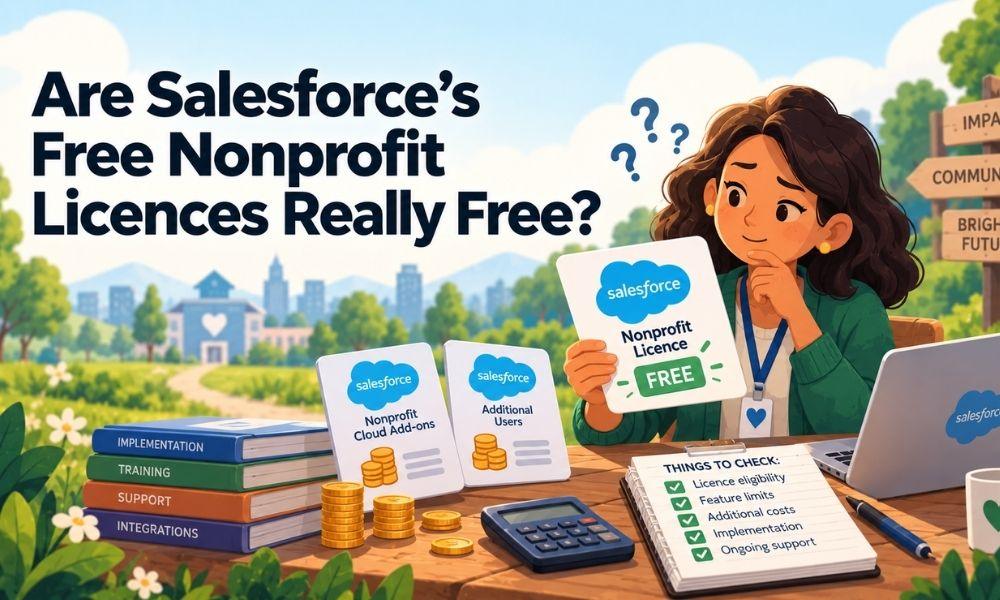
Yes, eligible charities can receive donated Salesforce licences through the Power of Us Programme.
But a free software licence and a free Salesforce implementation are two very different things.
As of October 2026, Salesforce states that eligible nonprofit organisations can receive 10 donated licences through its Power of Us Programme. Approved organisations can choose either 10 Agentforce Nonprofit Enterprise Edition licences, formerly Nonprofit Cloud, or 10 Sales and Service Enterprise Edition licences.
Those donated licences can significantly reduce the cost of accessing Salesforce.
They do not remove the work required to turn Salesforce into a useful, reliable system for your charity.
At Sweet Potato Tec, our Salesforce for Charities & Non-Profits work looks at that complete picture. The right budget needs to account for what the charity wants Salesforce to achieve, the condition of its data, integrations, implementation, training and what happens after go-live.
Is Salesforce really free for charities?
Eligible nonprofits can currently receive 10 donated Salesforce licences through the Power of Us Programme at no licence cost. However, charities may still need to budget for implementation, configuration, data cleansing and migration, integrations, training, change management, additional licences or products and ongoing administration or support. The donated licences reduce software costs, but they do not make a complete Salesforce solution automatically free.
What free Salesforce licences can eligible nonprofits currently receive?
Salesforce’s Power of Us Programme currently provides eligible nonprofit organisations with a choice of two donated licence bundles.
As of October 2026, an approved organisation can request:
10 Agentforce Nonprofit Enterprise Edition licences, formerly referred to as Nonprofit Cloud,
or
10 Sales and Service Enterprise Edition licences.
Salesforce states that the donated licences are free of charge and do not expire, although they remain subject to Salesforce’s Master Subscription Agreement and applicable product-specific terms.
This is a meaningful benefit.
For a small charity, ten donated licences may cover a significant proportion of the people who need direct Salesforce access.
For a larger organisation, they can reduce the starting software cost even where additional users are required.
Salesforce also currently offers discounts on additional licences and products for eligible nonprofit organisations.
However, charities should always check the current Power of Us Programme terms and pricing directly with Salesforce before budgeting or making a purchasing decision.
Products, allowances, eligibility and pricing can change.
Who is eligible for Salesforce’s donated nonprofit licences?
Organisations need to meet Salesforce’s Power of Us eligibility requirements and complete the application process before receiving donated licences.
Salesforce assesses eligibility through the Power of Us application.
The application requires organisations to provide appropriate legal and organisational documentation. Salesforce’s current guidance also states that approved organisations generally receive one donation per organisation, with specific provisions applying to areas such as fiscal sponsorship.
The important point is not to assume that using the word “charity” or “nonprofit” automatically guarantees a particular Salesforce donation.
Check the current eligibility requirements first.
This should happen early in the planning process, not after the charity has designed an implementation around an assumed licence arrangement.
Once eligibility and the available donation are understood, the organisation can make a more realistic decision about which Salesforce products and licences it actually requires.
What do the donated Salesforce licences actually cover?
The donated licences provide access to the relevant Salesforce software entitlement. They do not automatically design, configure or implement Salesforce around your charity.
That distinction is at the heart of the “free Salesforce” question.
Think of the licence as access to the platform.
The organisation still needs to determine how that platform should work.
For example:
How should supporters be represented?
How should fundraising processes work?
Do volunteers need to be managed?
Are programmes or services being tracked?
What reports do trustees and funders require?
Does Salesforce need to integrate with the website?
What happens to information in the existing database?
Who needs access?
Which processes should be automated?
Those decisions do not happen simply because Salesforce provisions licences.
Sweet Potato Tec’s Salesforce implementation work includes discovery, solution design, configuration, data migration, testing, training and go-live support.
That is the work that turns access to Salesforce into a system designed around the organisation.
Why does a charity still need discovery and process design?
Discovery determines what Salesforce actually needs to solve before money is spent building it.
Skipping this stage because the licences were donated can create much larger costs later.
A charity may begin with a seemingly simple objective such as:
“We need a new donor database.”
Once stakeholders are involved, the requirement may prove much broader.
Fundraising wants donation and supporter management.
The volunteer team wants applications and scheduling.
Services need programme information.
Finance needs reliable information flowing into another system.
Marketing needs communication preferences.
Leadership wants dashboards.
The website needs to exchange information with Salesforce.
Those requirements need to be understood before configuration begins.
At Sweet Potato Tec, we start by understanding the organisation rather than arriving with a predetermined Salesforce design.
That approach is particularly important for nonprofits because different charities can have very different operating models even when they appear similar from the outside.
Discovery is not an unnecessary cost around “free” software.
It is part of making sure the organisation spends its available budget on the right solution.
What should charities budget for when implementing Salesforce?
A realistic Salesforce budget should consider the complete cost of creating and maintaining the system, not simply the cost of licences.
The main areas can include:
Discovery and solution design
The organisation needs to define objectives, processes, users, reporting requirements, data and integrations before the platform is configured.
Configuration and implementation
Salesforce needs to be set up around the charity’s agreed processes.
The amount of work depends on the complexity of the organisation and how much can be delivered using standard functionality.
Data cleansing and migration
Existing supporter, donor, volunteer, membership or service information may need to be cleaned, mapped, transformed, migrated and validated.
Integrations
Websites, donation platforms, finance tools, event platforms and other systems may need to exchange information with Salesforce.
Testing
Processes, permissions, automation, integrations and migrated data need to be tested before launch.
Training and change management
People need to understand how the new system works and how their day-to-day processes are changing.
Additional licences and products
The donated allowance may not cover every user or every Salesforce capability the charity requires.
Ongoing administration and support
Salesforce continues to change after go-live. Users change, processes evolve and new requirements emerge.
Not every charity will incur the same costs in each area.
That is why a realistic budget begins with requirements rather than an assumed implementation package.
Why can data migration add to the cost?
Data migration is rarely just a matter of exporting a spreadsheet and importing it into Salesforce.
Existing charity data can contain:
duplicate supporters,
missing information,
obsolete fields,
inconsistent formats,
historic records,
poorly defined relationships,
and information spread across several systems.
Someone needs to decide what should move, how it should be represented in Salesforce and what should be cleaned before migration.
The data then needs to be tested and validated.
Moving poor-quality information into Salesforce without addressing the underlying issues simply creates a new CRM containing old problems.
Sweet Potato Tec’s implementation approach includes data migration and data-quality governance for exactly this reason.
The cost depends on the condition and complexity of the existing data.
A small charity with one clean supporter database will have a very different migration from an organisation with years of records spread across fundraising software, spreadsheets, websites and other systems.
Before requesting implementation quotes, understand the data you are asking a partner to move.
Are integrations included with free Salesforce licences?
No. Donated Salesforce licences do not mean that every external system your charity uses will automatically be integrated with Salesforce.
Integrations are a separate implementation consideration.
A charity may need to connect Salesforce with:
its website,
online donation tools,
payment systems,
event platforms,
finance software,
marketing platforms,
or other operational applications.
The integration work depends on the systems involved and what information needs to move between them.
Sweet Potato Tec provides dedicated Salesforce integration services covering discovery, architecture, implementation and ongoing support.
The Charity Retail Association demonstrates why this can matter.
Its website and Salesforce previously operated in silos. Event information was handled manually, and staff relied on spreadsheets for reporting.
Sweet Potato Tec connected Salesforce with the organisation’s website for real-time information sharing and integrated Eventbrite to automate event creation and registration syncing.
The value came from the connected system.
Those integrations required implementation work beyond simply having access to Salesforce licences.
Do charities need to budget for training and change management?
Yes. A technically correct Salesforce implementation can still fail to deliver value if people do not understand or adopt it.
Training should therefore be part of the implementation plan.
But adoption involves more than teaching staff which buttons to click.
Users need to understand:
why processes are changing,
what information they are responsible for,
how data should be entered,
what the new workflows mean,
where they should go for help,
and how Salesforce supports their role.
Change management becomes particularly important when the project replaces spreadsheets or familiar legacy systems.
People may have developed workarounds over many years. Some of those processes may no longer be required. Others may reveal important requirements that the new system needs to support.
The Charity Retail Association project included user-focused training specifically to build confidence and support long-term system use.
That is part of the implementation, not something to consider only if adoption goes wrong.
What happens if a charity needs more than ten Salesforce licences?
Salesforce currently states that eligible nonprofits can receive discounts on additional licences beyond the donated allowance.
The organisation should therefore identify how many people genuinely need Salesforce access before finalising its budget.
Do not automatically give every employee the same licence.
Start with roles and requirements.
Who needs to work directly in Salesforce?
What do they need to do?
Which product capabilities do they require?
Could different users have different requirements?
Are there additional products involved?
Licensing decisions can become more complicated as the Salesforce environment expands.
Sweet Potato Tec’s Salesforce implementation service includes advice around selecting appropriate Salesforce products, licences and third-party tools.
The aim should be to buy what the organisation genuinely needs rather than allowing the donated licence offer to dictate the architecture.
Could a charity need additional Salesforce products?
Yes. The donated licence offer should not be interpreted as meaning every Salesforce product or capability the charity might want is automatically included at no cost.
Salesforce has a much wider product ecosystem.
Depending on the requirements, an organisation may consider additional functionality, products, storage, integrations, analytics or third-party applications.
Some products may have separate licensing or commercial arrangements.
That is why requirements should be mapped before the budget is approved.
A charity may discover that its core needs fit comfortably within the donated entitlement.
Another may need additional capabilities because Salesforce is expected to support a much wider operating model.
Neither situation means the Power of Us donation is misleading.
It means a donated core licence and the complete technology architecture are different things.
Always verify the current entitlement and pricing of any additional Salesforce product directly with Salesforce before committing to it.
What does ongoing Salesforce support cost?
Ongoing costs depend on how the charity chooses to administer and develop Salesforce after implementation.
Some organisations have experienced Salesforce administrators internally.
Others need external support.
Many use a combination.
After launch, work can include:
user and permission changes,
data stewardship,
new reports and dashboards,
new automation,
small configuration changes,
integration support,
health checks,
security and data-privacy work,
release management,
training,
and strategic planning.
Sweet Potato Tec’s Managed Services for Nonprofits are designed for charities that need ongoing Salesforce and IT support without necessarily maintaining all of that capability internally.
SPT’s wider managed-services offering includes Salesforce configuration, data uploads, data stewardship, reporting, automation, health checks, integration support, security and change management.
This should be considered before go-live.
A Salesforce implementation needs an owner after the implementation project finishes.
If nobody is responsible for data quality, user support and evolving requirements, the platform can gradually become less useful regardless of what the licences originally cost.
How can a charity create a realistic Salesforce budget?
Start by separating software cost from solution cost.
The donated licences belong in the first category.
Everything required to make the system useful belongs in the second.
A practical budgeting exercise should answer:
Which donated licences are we eligible for?
Verify this with Salesforce.
How many users need access?
Identify roles rather than estimating broadly.
What do we need Salesforce to do?
Define the processes, reporting and outcomes.
What data needs to move?
Assess its volume, quality and complexity.
Which systems need to integrate?
Include websites, donations, payments, finance, marketing and events where relevant.
What needs configuring or developing?
Separate core requirements from desirable extras.
What training and change support is needed?
Consider both launch and ongoing adoption.
Who will own Salesforce afterwards?
Decide whether that capability will be internal, external or mixed.
Which additional products might be required?
Verify current licensing and pricing rather than assuming they are part of the donation.
Once these questions are answered, the charity can compare implementation options on a more meaningful basis.
The objective is not to turn donated licences into a negative.
It is to make sure the organisation understands the full investment required to turn them into something useful.
What should a charity prepare before speaking to a Salesforce partner?
You do not need a complete technical specification.
You do need a clear picture of the organisation.
Before an initial conversation, it is useful to document:
the main problems you want to solve,
the teams that will use Salesforce,
your current systems,
your main data sources,
important integrations,
key reporting requirements,
approximate user numbers,
known data-quality problems,
your internal technical capacity,
and what success would look like.
This gives a Salesforce partner a much stronger basis for discussing scope and cost.
At Sweet Potato Tec, our approach is to understand the organisation first and then determine how technology can help.
For charities working with limited budgets, that matters.
The simplest solution that achieves the required outcome is usually more useful than implementing functionality simply because it is available.
FAQs
How many free Salesforce licences can a UK charity get?
As of October 2026, Salesforce states that eligible nonprofits approved through the Power of Us Programme can receive 10 donated licences. Organisations can currently choose 10 Agentforce Nonprofit Enterprise Edition licences, formerly Nonprofit Cloud, or 10 Sales and Service Enterprise Edition licences. Always check Salesforce’s current programme terms before making a purchasing decision.
Do Salesforce’s donated nonprofit licences expire?
Salesforce currently states that the donated licences provided through the Power of Us Programme are free of charge and do not expire, although they remain subject to Salesforce’s Master Subscription Agreement and relevant product terms.
Does the Power of Us Programme include free Salesforce implementation?
No. The donation provides eligible Salesforce licences. Discovery, configuration, data migration, integrations, testing, training and other implementation work are separate considerations. A charity may use internal resources, a Salesforce partner or a combination to deliver that work.
Does a charity have to pay if it needs more than ten Salesforce licences?
Salesforce currently provides discounts on additional licences for eligible nonprofit organisations. The exact cost depends on the licences and products required, so charities should obtain current pricing directly from Salesforce.
Can a small charity implement Salesforce itself?
Potentially. The right approach depends on the complexity of its requirements, data, integrations and available internal Salesforce expertise. A straightforward requirement may need less external support than a multi-team implementation involving legacy data, automation and several integrations. The important question is whether the organisation has the capability to configure and maintain the system reliably.
What is the biggest hidden cost of free Salesforce licences?
There is no single hidden cost that applies to every charity. The most commonly overlooked areas are likely to be the work surrounding the software: discovery, data preparation, migration, integration, training, change management and ongoing administration. A proper assessment should identify which of those genuinely apply before the organisation commits to the project.
Free licences can be valuable, but budget for the complete system
Salesforce’s donated nonprofit licences are a genuine and potentially significant benefit.
For eligible organisations, the Power of Us Programme can remove the licence cost for the first ten qualifying users under the current offer.
That can make powerful CRM technology much more accessible to charities.
But access to software is only the starting point.
A useful Salesforce environment still needs to reflect the charity’s processes, contain reliable data, connect with the right systems and be understood by the people using it.
At Sweet Potato Tec, our Salesforce for Charities & Non-Profits work considers that complete picture.
Our work with the Charity Retail Association demonstrates why. The project involved stakeholder discovery, platform configuration, data transfer, website and Eventbrite integrations, automation, training and ongoing maintenance.
The Salesforce licence was only one part of the technology required to create the result.
If your charity is considering Salesforce because of the Power of Us Programme, start by confirming your current eligibility and licence entitlement directly with Salesforce.
Then map the processes, people, data, integrations and ongoing support needed to turn those licences into a sustainable CRM.
That gives you a much more useful answer to the question of what Salesforce will really cost.