
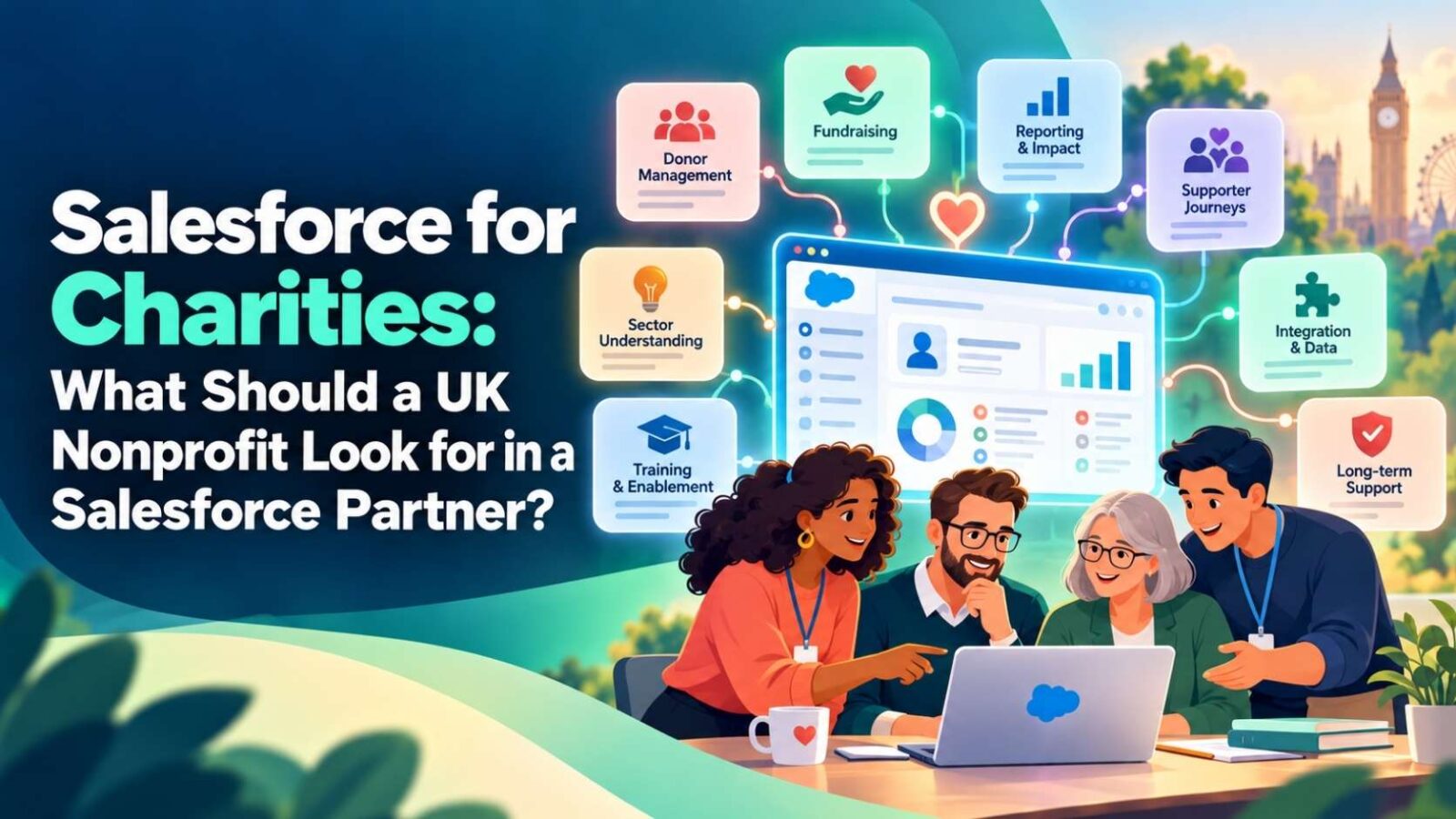
A UK nonprofit should look for a Salesforce partner that understands both Salesforce and the way charities actually operate. That means understanding donor and supporter relationships, fundraising, grants, volunteers, service delivery, impact reporting and the financial and resource constraints that influence technology decisions in the nonprofit sector.
Technical Salesforce capability matters, but it is not enough on its own.
At Sweet Potato Tec, our Salesforce for charities and nonprofits work is built around the organisation’s mission and operating model. We work with charities, associations and membership bodies to implement and optimise Salesforce across areas including donor management, fundraising, volunteer engagement, reporting and automation.
The right Salesforce partner should not begin by asking how many Salesforce features it can implement.
It should begin by understanding how your charity works, where time and data are currently being lost, and what Salesforce needs to improve.
Key takeaway: what should a charity look for in a Salesforce partner?
Look for a partner with genuine nonprofit Salesforce experience, an understanding of charity operating models and the technical capability to handle data, integrations, automation and reporting. The partner should also prioritise usability, adoption and long-term value rather than over-engineering the CRM.
Most importantly, ask for evidence. A partner saying it “understands charities” is less useful than being able to show how it has solved real nonprofit problems.
1. Does the Salesforce partner genuinely understand nonprofits?
A Salesforce partner working with a charity needs to understand that nonprofit organisations do not simply operate like commercial businesses with different terminology.
The operating model can be fundamentally different.
A charity may need to manage relationships with donors, beneficiaries, volunteers, members, corporate supporters, grant funders and other stakeholders. Income may come from several different sources. Service delivery and fundraising may sit alongside one another. Reporting requirements may involve trustees, funders and other stakeholders as well as internal management.
Different types of nonprofits have different requirements again.
For example, Sweet Potato Tec’s work around Salesforce for human services charities considers service delivery, case activity, outcomes reporting and appropriate access to sensitive information.
Our Salesforce for animal charities work can involve donor and volunteer information alongside foster networks and rehoming activity.
For associations and membership organisations, membership lifecycles, renewals, events and stakeholder engagement become particularly important.
The first question to ask a prospective Salesforce partner is therefore not simply, “Have you worked with Salesforce?”
Ask: “Have you worked with organisations that operate like us?”
That domain knowledge can affect everything from the data model to the reports users need.
2. Does the partner understand Salesforce Nonprofit Cloud and the wider Salesforce platform?
A charity Salesforce partner should understand the nonprofit-specific capabilities available within the Salesforce ecosystem, but should also be able to determine which capabilities your organisation actually needs.
Sweet Potato Tec works with Salesforce Nonprofit Cloud and supports nonprofit requirements around donors and supporters, fundraising and grants, volunteers, programme activity and impact reporting.
The important word is requirements.
A good implementation should not begin with a predetermined list of Salesforce products and then look for somewhere to use them.
The partner needs to understand your processes first.
How do donations enter the organisation? How are supporter relationships managed? How are grants tracked? Do volunteers need to be coordinated? Does the charity deliver programmes or services? What does the board need to see? What information do funders expect?
Only then should the Salesforce solution be designed.
This principle is part of Sweet Potato Tec’s wider Salesforce implementation approach, which begins with stakeholder workshops, existing systems and data, business goals, processes and project scope before moving into solution design.
For charities with limited resources, that discipline is particularly important. There is little value in paying for complexity that does not solve a real operational problem.
3. Can the Salesforce partner show relevant nonprofit experience?
Ask for examples of what the partner has actually delivered.
Case studies are useful because they move the conversation away from general claims and towards real problems, decisions and outcomes.
Sweet Potato Tec’s work with the Charity Retail Association provides one example.
The Charity Retail Association had several connected operational problems. Its website and Salesforce operated in silos. Membership renewals were tracked manually. Event details were manually posted to the website. Reporting relied heavily on spreadsheets, limiting timely visibility for the organisation.
Sweet Potato Tec worked with key stakeholders to understand those problems before implementing an integrated Salesforce solution.
Salesforce was connected with the Charity Retail Association’s website to support real-time data synchronisation. An Eventbrite integration improved event information and registration syncing. Membership renewals and other workflows were automated, while user-focused training supported adoption.
The outcome was not simply “Salesforce was implemented”.
Teams could work from shared, up-to-date information, manual tasks and errors were reduced, and the organisation had a platform capable of supporting ongoing improvement.
That is the type of evidence a charity should look for.
Ask the prospective partner what the problem was, what they changed and what happened afterwards.
4. Will the partner design Salesforce around your charity or around a template?
A good nonprofit Salesforce implementation should reflect how the organisation actually operates.
Templates and established patterns can accelerate delivery, but they should not force a charity into processes that do not fit its work.
At Sweet Potato Tec, we describe this as building Salesforce around nonprofit operating models.
For one organisation, donor management may be central. For another, grant-funded service delivery may matter more. A membership body may need sophisticated renewal and events processes. A volunteer-led charity may prioritise scheduling, engagement and communication.
Those differences should influence Salesforce design.
A useful partner should therefore spend time in discovery with the people who understand the work.
That includes leadership, but it should not necessarily stop there. Fundraising teams, operations, finance, service delivery teams and the people who will actually use Salesforce can expose requirements that are difficult to understand from a management-level specification alone.
In the Charity Retail Association project, Sweet Potato Tec collaborated with retail operations and member services during discovery to understand pain points and future needs before designing the Salesforce solution.
That is a much stronger foundation than configuring a standard CRM and asking the organisation to adapt afterwards.
5. Will the Salesforce implementation be simple enough for people to use?
A charity should look for a partner that treats adoption as part of the implementation, not a problem to deal with after launch.
A technically impressive Salesforce environment has limited value if staff and volunteers avoid using it.
Nonprofits can have particularly varied user groups. Some employees may use Salesforce every day. Others may access it less frequently. Volunteers or occasional users may have very different levels of technical confidence.
The system therefore needs to be appropriate for the people using it.
Sweet Potato Tec’s nonprofit approach is deliberately focused on avoiding unnecessary complexity. Our Salesforce for Charities & Non-Profits proposition includes training and documentation so staff and volunteers can use Salesforce confidently as part of their day-to-day work.
Training is important, but adoption begins before training.
If processes are unnecessarily complicated, fields do not make sense or users have to complete extra work without receiving anything useful in return, a training session will not correct the underlying design.
Ask a potential partner how users will be involved during discovery, testing and implementation, not just how much training will be provided at the end.
6. How will the partner handle existing charity data?
A charity Salesforce partner should have a clear plan for understanding, cleaning, mapping, migrating and testing existing data.
That is particularly important for organisations moving from spreadsheets, legacy CRMs or several disconnected systems.
Historical donor, member, volunteer or service information may be valuable, but simply moving every existing record into Salesforce does not guarantee useful data.
Before migration, the organisation and its partner need to understand what information exists, what needs retaining, where duplicates or inconsistencies are present and how the new Salesforce structure will represent it.
Sweet Potato Tec’s nonprofit services include migration from spreadsheets and legacy systems, including data mapping, migration and testing.
Data decisions also affect what comes afterwards.
Reporting, automation, supporter journeys and future AI capabilities all depend on the quality and structure of the underlying information.
A prospective partner should therefore be able to explain its migration process in more detail than “we’ll import your data”.
7. Can the partner connect Salesforce with the systems your charity already uses?
A Salesforce implementation should not create a new data silo.
Most charities use other technology alongside their CRM. Depending on the organisation, that might include a website, event platform, finance system, forms or other operational tools.
The partner should establish what needs to connect with Salesforce and why.
Sweet Potato Tec’s Salesforce integration capability covers discovery, architecture, implementation and ongoing support for integrations.
The Charity Retail Association project demonstrates this in a nonprofit environment.
Rather than treating Salesforce as an isolated database, SPT integrated it with the organisation’s website and Eventbrite. The website integration enabled real-time information synchronisation, while Eventbrite integration automated event creation and registration syncing.
This addressed real operational problems: information previously sat in silos, event details required manual updates and inconsistent data created coordination problems.
When speaking to a prospective partner, ask what will become the source of truth, what information needs to move between systems and what manual work the integration is intended to remove.
An integration should solve an operational problem, not exist simply because two systems can technically be connected.
8. Does the partner understand charity reporting and impact requirements?
Reporting should be discussed during discovery, not added at the end of a Salesforce project.
Charities need different kinds of information for different audiences.
Operational teams need information that helps them work. Leadership needs visibility across performance and resources. Boards and trustees may need higher-level reporting. Funders may require evidence about outcomes or programme activity.
Sweet Potato Tec’s nonprofit Salesforce services include real-time dashboards and reports, outcome and impact tracking and information that can support funding applications and reviews.
But dashboards are only useful when the underlying data can be trusted.
This is why reporting requirements need to influence the data model and processes from the beginning.
Ask a prospective partner:
What information will our teams need regularly?
What does leadership need to know?
What do trustees need?
What evidence do funders require?
Where does that information currently come from?
What needs to happen in Salesforce for those reports to be reliable?
The Charity Retail Association project again provides useful evidence. Before SPT’s work, reporting relied on spreadsheets and leadership lacked timely data for decision-making. The integrated Salesforce platform was designed to improve data visibility rather than simply reproduce the existing manual reporting process.
9. Will the partner be realistic about your budget and resources?
A nonprofit Salesforce partner should understand that cost is not the only resource constraint a charity faces.
Internal time matters too.
A charity may have a small operations team, limited technical resource and staff already balancing several responsibilities. An implementation that demands excessive internal administration can create problems even if the technology itself is appropriate.
Sweet Potato Tec’s nonprofit approach focuses on practical outcomes and avoiding unnecessary features or over-engineering.
That is important when evaluating proposals.
A larger Salesforce implementation is not automatically a better one.
Ask what is genuinely required for the first phase, what can reasonably wait and which elements create the greatest operational value.
A phased approach can allow the organisation to establish strong foundations and improve the platform over time rather than trying to solve every possible future requirement in the initial implementation.
The partner should also be able to help you understand relevant Salesforce licensing options rather than making assumptions about what your organisation requires.
10. What happens after Salesforce goes live?
Ask this before signing the implementation agreement.
Salesforce will need to evolve after launch.
Users will identify improvements once they begin working with the system. Processes will change. Reporting requirements will develop. New integrations may become necessary. Salesforce itself will continue to change.
A partner that disappears at go-live leaves the organisation responsible for all of that.
Sweet Potato Tec provides Managed Services for Nonprofits for organisations that need ongoing Salesforce and IT support without maintaining the same capability in-house.
SPT’s wider Managed Services model also includes configuration, data stewardship, reports and dashboards, health checks, integration support, Salesforce roadmapping and continuous improvement.
This does not mean every charity needs a large ongoing support agreement.
It means the organisation should know what happens when something needs changing.
Who provides support? How are requests handled? Who understands the Salesforce configuration? How will new requirements be prioritised? How will platform changes be managed?
The implementation is only the beginning of the CRM’s useful life.
What questions should a charity ask a Salesforce partner?
Before appointing a Salesforce partner, ask questions that reveal how they actually work rather than simply what they sell.
Useful questions include:
- What experience do you have with charities or nonprofits like ours?
- Which Salesforce nonprofit products and operating models have you worked with?
- Can you show us a relevant nonprofit implementation or case study?
- How will you understand our processes before designing the solution?
- How will staff, volunteers and other users be involved?
- How will you approach our existing data?
- Which of our existing systems should integrate with Salesforce?
- How will reporting requirements influence the implementation?
- How will you prevent the solution becoming unnecessarily complex?
- What will you need from our internal team?
- How will users be trained and supported?
- What happens after go-live?
- How will you decide what belongs in phase one and what should wait?
- How will we know whether the Salesforce implementation has succeeded?
The answers should tell you considerably more than a list of Salesforce certifications alone.
Technical capability matters. So does whether the partner understands what your organisation is actually trying to achieve.
FAQs
Is Salesforce suitable for UK charities?
Yes. Salesforce can be configured around nonprofit requirements including donor and supporter management, fundraising, grants, volunteers, programmes and impact reporting. The important factor is designing Salesforce around the charity’s actual operating model rather than treating it as a generic commercial CRM.
What is Salesforce Nonprofit Cloud?
Salesforce Nonprofit Cloud is Salesforce technology designed around nonprofit requirements. Sweet Potato Tec works with Nonprofit Cloud and wider Salesforce capabilities to support areas including fundraising, supporter management, programmes, volunteering and reporting.
Does a charity need a specialist Salesforce nonprofit partner?
A charity is not required to use a particular type of consultancy simply because it is a nonprofit, but relevant sector experience can be valuable. A partner familiar with charity operating models is better placed to understand requirements such as donor relationships, grants, volunteers, service delivery, impact reporting and nonprofit resource constraints.
Can a Salesforce partner migrate a charity away from spreadsheets?
Yes. Sweet Potato Tec helps charities move from spreadsheets and legacy systems into Salesforce, including data mapping, migration and testing. The migration should also be an opportunity to assess data quality and determine which information genuinely needs to move into the new CRM.
Can an existing charity Salesforce implementation be improved without starting again?
Yes. Problems with reporting, data, workflows or usability do not automatically require a completely new implementation. The existing environment should first be assessed to determine what can be retained and what needs fixing or optimising.
Does Sweet Potato Tec provide ongoing Salesforce support for charities?
Yes. Sweet Potato Tec provides Managed Services for Nonprofits as well as ongoing Salesforce optimisation and support. This allows nonprofit organisations to access Salesforce expertise without necessarily maintaining the equivalent resource internally.
Choose a Salesforce partner that understands the organisation behind the CRM
Choosing a Salesforce partner for a charity is not simply a technical procurement decision.
The partner will make decisions about how your organisation’s donors, supporters, members, volunteers, services, programmes and data are represented in Salesforce. Those decisions can affect how easily people use the CRM, how reliably the organisation reports and how straightforward it is to make changes later.
Look for Salesforce capability, but also look for evidence of nonprofit understanding.
Ask how the partner approaches discovery. Ask for relevant examples. Discuss data, integrations and reporting early. Find out how users will be involved. Challenge unnecessary complexity. And establish what support will be available once the implementation goes live.
At Sweet Potato Tec, our Salesforce for Charities & Non-Profits work is designed around the way mission-driven organisations actually operate. Our experience includes charities, associations and membership organisations, with services covering implementation, optimisation, integrations and ongoing support.
Our work with the Charity Retail Association demonstrates that approach in practice: understanding the organisation’s operational problems first, then using Salesforce, automation and integrations to address them.
For a UK nonprofit choosing a Salesforce partner, that is ultimately what matters.
Do not start by asking who can build the most Salesforce.
Ask who can understand your organisation well enough to build the Salesforce you actually need.