
Every organisation depends on technology. Finance has one system. Sales has another. Marketing has its own platform. Customer service relies on something else. Individually, they often work well. The challenge is what happens between them.
When systems don’t share information properly, people end up doing the work instead. That’s where integration makes the difference.
Our view
Not between people. Between systems.
None of this feels dramatic. It simply becomes part of everyday work — until somebody asks how much time is being wasted, or why reports never quite match. Those are usually integration challenges, not software failures.
The best integrations are often the ones nobody notices.
Information appears where it needs to.
Teams stop copying and pasting data.
Processes happen automatically.
Departments work from the same information.
People spend less time updating systems and more time doing the work that actually matters. Not more technology — less unnecessary effort.
Scope
Every organisation has its own technology landscape, but we regularly help clients connect:
The objective is always the same. Create one connected organisation rather than a collection of disconnected systems.
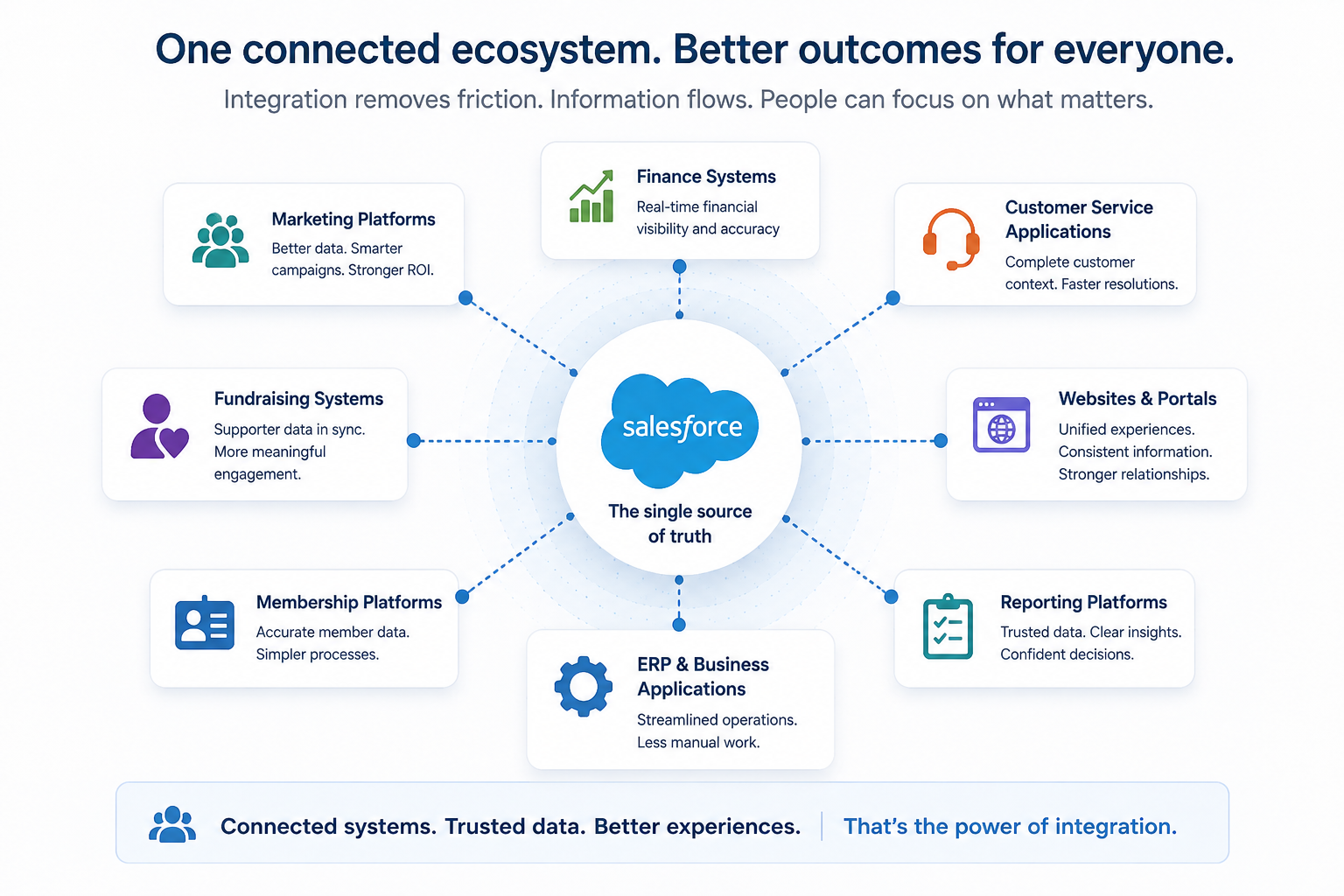
There are lots of ways to connect systems. Boomi is one of the platforms we regularly recommend because it’s flexible, reliable and designed to help organisations integrate technology without creating unnecessary complexity.
More importantly, it allows organisations to build an integration strategy that can evolve as the business grows.
But technology should never drive the recommendation. If Boomi is the right solution, we’ll explain why. If another approach is better suited, we’ll tell you that instead.
We don’t begin by asking which systems you want to connect. We begin by asking how your organisation works.
Sometimes the biggest improvement comes from one integration. Sometimes it comes from several smaller changes. The answer depends entirely on your organisation.
For your team. For your customers. For your supporters. For your partners.
When systems share information properly, people spend less time chasing answers and more time helping the people they’re there to support. That’s why we see integration as a business improvement project rather than simply a technical one.
We’ve helped organisations connect Salesforce with the wider systems they rely on every day. That experience means we understand both the technical challenge and the practical one.
Technology has to fit around the way people work — not expect people to change the way they work simply because a system says so.
We’ll help you build integrations that make everyday work simpler, faster and more reliable.

Success Stories Every donation starts with a person. Someone responds
Boomi is an integration platform that helps different business systems communicate with one another automatically. It enables information to move securely between applications, reducing manual work and improving consistency across the organisation.
Not necessarily. Boomi is one of several integration technologies available. The right solution depends on your existing systems, your objectives and how your organisation operates. We’ll recommend the approach that’s best suited to your environment.
In many cases, yes. Modern integration platforms make it possible to connect a wide range of applications, helping organisations reduce duplication and improve the flow of information across the business.
Absolutely. Many organisations come to us because existing integrations have become difficult to maintain, don’t deliver the information people need or no longer reflect the way the organisation operates. Reviewing and refining those integrations can often deliver significant improvements without replacing everything.
No. Any organisation relying on multiple business systems can benefit from better integration. The scale of the solution may vary, but the principle remains exactly the same.
Your systems should support the way your organisation works, not create more work for the people using them. If you’d like to explore how better integration could simplify processes, improve reporting and reduce manual effort, we’d be delighted to have a conversation.