We have rolled out multiple agents across our client ecosystem. Agentforce has the potential to transform how organisations operate. Yet many initiatives never move beyond the pilot stage. In our experience, the reasons are usually straightforward and similar to other technology programmes.
Start with a Clear Strategic Objective
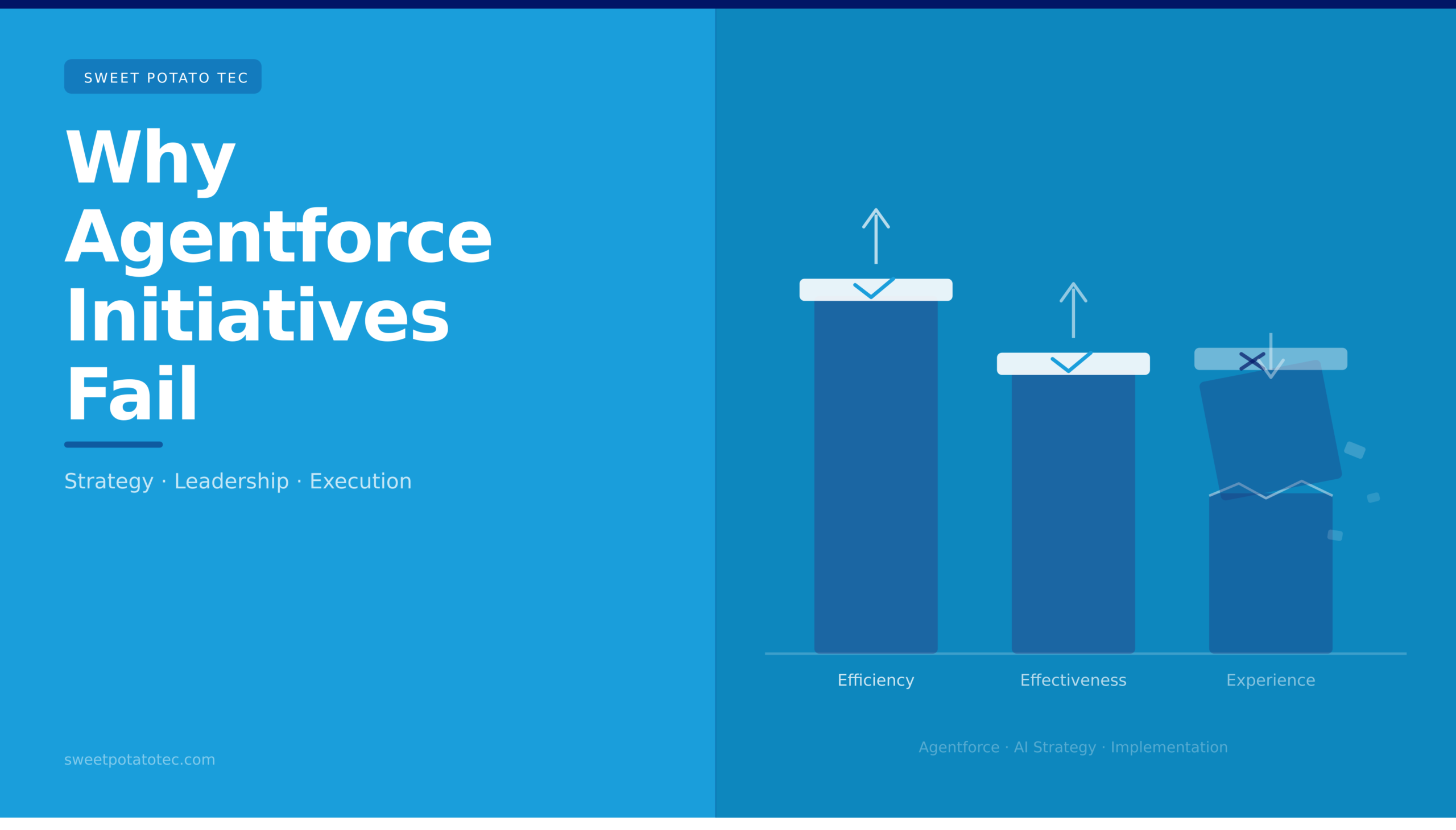
A successful Agentforce implementation must be anchored in one of three strategic objectives:
Objective 1
Efficiency
Reducing manual effort and operational friction. Save time for your people.
Objective 2
Effectiveness
Improving revenue outcomes and decision-making. Make more money.
Objective 3
Experience
Enhancing customer or employee interactions. Delight your customers and colleagues.
Select Leaders Who Will Make It Work
Recently, we spoke with two exceptional leaders. Not the kind who rely on posturing, buzzwords, or the allure of the latest technology trend. These were execution-focused, data-driven individuals who cared deeply about measurable business outcomes.
100
Cases closed without a single human touchpoint
A leader focused on Sales Operations efficiency removed friction from internal processes with a clear, measurable result.
$90k
Deal directly attributed to Agentforce
A leader focused on Sales effectiveness used Agentforce to enhance revenue generation, linking AI adoption directly to business growth.
What stood out was their shared mindset:
No posturing
Decisions were not driven by hype or internal politics.
Data-led thinking
Each initiative was grounded in measurable KPIs.
Bias for action
Both leaders focused on rapid execution and real outcomes.
Alignment with strategy
Their chosen use cases directly addressed organisational priorities.
There is no universally correct starting point. The key is alignment with business objectives and the ability to create immediate momentum and excitement.
The Power of the Outlandish Question
Sometimes the right use case needs to be invented. It often starts with a bold question that challenges the status quo:
Ask yourself:
What if all inbound sales leads were handled by an Agent?
What if every order amendment could be processed automatically from a sales email?
These bold questions unlock high-impact opportunities and help organisations reimagine what is possible.
The Data Reality: Progress Over Perfection
Poor data quality is a well-known failure point. Agents are only as effective as the data they rely on, but waiting for perfect data is a mistake.
In SDR scenarios, we validate email addresses using tools like ZeroBounce before an agent engages. We also combine proprietary data cleansing techniques with pragmatic approaches to ensure reliability for targeted use cases.
The principle is simple: you do not need perfect data, only reliable data for the specific task.
Don't Automate Faster Chaos
Technology alone does not guarantee success. Process alignment is crucial. In the SDR agent use case, Marketing and Sales must be aligned on target audience, offer and copy. Many organisations also carry years of complexity in:
Lead qualification criteria
Lead assignment and routing
Attribution logic
Introducing an agent into this environment without addressing these ambiguities does not solve the problem. It simply accelerates existing inefficiencies. Poor routing creates faster chaos. Establishing safeguards to prevent unqualified or duplicate leads from entering the pipeline is essential before switching the solution on.
Key Takeaways
1
Pick a pillar
Efficiency, Effectiveness, or Experience. Be clear on which one before you start.
2
Follow outcome-driven leadership
Avoid hype and focus on measurable value from day one.
3
Ask bold questions
This is where transformative use cases emerge.
4
Clean data pragmatically
Do not wait for perfection. Focus on reliable data for the specific task.
5
Fix the process first
Avoid scaling existing problems. Get the foundations right before switching on.
The difference between Agentforce initiatives that deliver and those that stall is rarely the technology. It is the clarity of objective, quality of leadership, and discipline of execution.