
More sales conversations without more manual prospecting
Growth creates opportunity, but it also creates more people to identify, research, contact, qualify and follow up.
For CyberRisk Alliance, sales teams were working across two very different types of opportunity. Inbound leads needed a fast, relevant response while their interest was still fresh. Outbound activity required the team to identify and engage new prospects across a much larger audience.
Both relied heavily on sales representatives carrying out repetitive work manually.
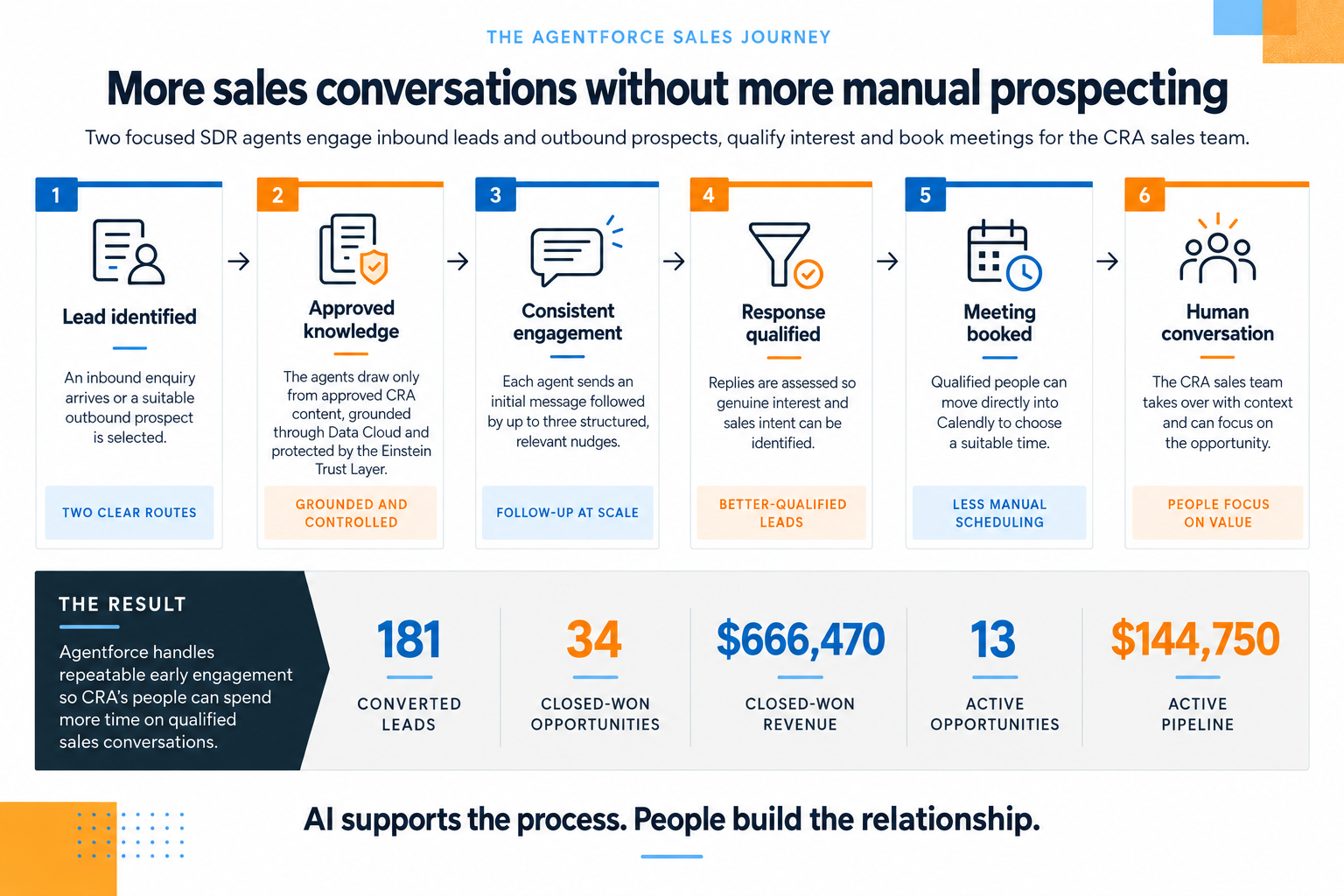
Sweet Potato Tec worked with CyberRisk Alliance to create two Agentforce SDR agents, each designed around a different part of the sales process. Together, they have engaged more than 2,000 leads, converted 181 and supported a shared pipeline that has produced $666,470 in closed revenue, with a further $144,750 in active opportunities.
Closed revenue
$666,470
Active pipeline
$144,750
Converted leads
181
Closed-won opportunities
34
Sector
Cybersecurity media, events and intelligence
Brands
Identiverse and InfoSec World
Services
Agentforce strategy and implementation, sales process automation, lead qualification, reporting, training and ongoing optimisation
Key platforms
Agentforce, Salesforce, Data Cloud, Marketo, Einstein Trust Layer and Calendly
Cybersecurity media, events and intelligence
About CyberRisk Alliance
CyberRisk Alliance connects cybersecurity professionals, business leaders and technology providers through trusted media, research, events and professional communities.
Its brands include SC Media, Dark Reading, CISO Series, Identiverse and InfoSec World.
The business runs account-based marketing programmes, integrated campaigns, industry events and research for technology providers that want to reach cybersecurity decision-makers. Its ability to identify the right prospects, engage them at the right time and turn interest into qualified opportunities is central to the value it provides.
As the organisation and its audiences grew, CRA wanted to increase this activity without making its sales teams responsible for an ever-growing volume of manual prospecting and follow-up.
The challenge
More opportunities meant more manual work
CRA’s sales representatives understood their audiences and knew how to have valuable commercial conversations. The difficulty was the amount of work required before those conversations could take place.
01
Inbound leads needed a faster response — someone expressing an interest in an event or CRA brand needed prompt and consistent engagement. Delays increased the risk that a promising lead would lose interest.
02
Qualification took time away from selling — representatives had to establish whether each lead was relevant before they could decide where to focus their attention.
03
Follow-up became harder at scale — every increase in lead volume created more messages and reminders for the sales team to manage.
CRA wanted to generate more pipeline, but increasing activity through manual effort alone would simply move the constraint elsewhere.
What would have happened if nothing had changed?
The sales team would have continued prospecting, qualifying and following up with leads. They were already doing that work.
The problem was capacity.
Outbound reach would remain closely tied to the amount of time available within the sales team.
Inbound response would depend on what else representatives were managing that day.
Maintaining consistent follow-up would become harder as the number of prospects increased.
CRA could have added more people, but that would not have improved the underlying process.
The opportunity was to give its existing sales team greater reach while allowing people to concentrate on the conversations where their experience and judgement mattered most.
Our approach
We started with the way CRA actually sells
The project did not begin by deciding which sales tasks AI could perform. Sweet Potato Tec first worked with CRA’s representatives to understand how inbound and outbound engagement happened in practice. We looked at where manual work consumed time, how the team assessed a potential opportunity and what needed to happen before a sales representative became involved. That work led to two separate Agentforce SDR agents. They share a common purpose, but they perform very different jobs.
1
The inbound agent: responding while interest is still fresh
The inbound agent engages people who have already shown an interest through channels such as Marketo. It responds using CRA-approved messaging, provides relevant information and follows up consistently. When someone is ready for a conversation, the agent routes the lead to the appropriate sales representative and provides a Calendly link so they can book a meeting. The inbound agent has engaged 274 leads, converted 155 leads and achieved a conversion rate of approximately 56%
2
The outreach agent: extending CRA’s reach into new audiences
The outreach agent supports proactive prospecting across Identiverse and InfoSec World. It contacts appropriate prospects, manages the initial engagement sequence and identifies people who respond positively. Qualified interest can then pass to the sales team for a human conversation. The outreach agent has contacted 1,821 prospects, converted 26 leads and achieved a conversion rate of approximately 1.4%. The two conversion rates should not be compared directly. The inbound agent works with people who have already expressed an interest, while the outreach agent begins conversations with new prospects.
3
How the Agentforce SDR process works
A lead enters the process: an inbound lead arrives through Marketo or the outreach agent identifies a relevant new prospect. The agent begins an approved engagement sequence, sending an initial message and up to three follow-ups using CRA’s approved templates and tone of voice. The agent responds and qualifies: when the prospect replies, the agent uses approved brand and campaign information to respond and determine the appropriate next step. The prospect can book a meeting through a Calendly link with a sales representative. Sales then takes over, with the representative entering the conversation with the context collected through the earlier engagement. The agent manages the repeatable work. CRA’s salespeople remain responsible for the relationship and commercial conversation.
4
Approved knowledge rather than open-ended answers
An AI sales agent represents the business every time it communicates with a prospect. Accuracy and control therefore mattered as much as speed. Sweet Potato Tec grounded the agents in information approved by CRA, including current brand prospectuses, marketing content and email templates. Data Cloud provides a central source of current brand information. Agentforce draws on that approved knowledge rather than creating answers from unrestricted information. The agents also operate within defined rules covering CRA’s tone, the questions they can answer and when they should hand a conversation to a person.
5
Safeguards built into the process
The Einstein Trust Layer provides additional controls around each interaction: sensitive data is masked before reaching the language model, toxicity detection helps prevent inappropriate responses, interactions are recorded so CRA can review what happened, approved prompts and templates control how agents respond and current brand information keeps responses relevant. The purpose was not to create an agent that could say anything. It was to create one that could reliably handle a clearly defined part of CRA’s sales process.
6
Adoption formed part of the implementation
The Agentforce deployment changed how leads reached CRA’s representatives, so the sales team needed to understand and trust the process. Sweet Potato Tec involved representatives in the rollout, gathered feedback and refined the agents based on real sales activity. This helped ensure that the technology supported CRA’s existing sales approach rather than imposing an unfamiliar process on the people expected to use it. It also provided a practical way to identify where the agent should continue a conversation and where human judgement should take over.
Scope of work
What Sweet Potato Tec delivered
- Agentforce SDR strategy and implementation
- Automated engagement and follow-up sequences
- Smart links within prospect communications
- CRA-approved email templates
- Defined tone and response rules
- Live reporting across leads, responses, meetings and opportunities
- Separate agents for inbound and outbound engagement
- Lead qualification and routing
- Calendly meeting scheduling
- Brand-specific knowledge through Data Cloud
- Sales team training and adoption support
- Ongoing Agentforce optimisation
Key integrations
Salesforce
Agentforce
Data Cloud
Calendly
Einstein Trust Layer
Capabilities
Agentforce
Agentforce
Data Cloud
Einstein Trust Layer
The outcome
More than 2,000 leads engaged through Agentforce
Across Identiverse and InfoSec World, the two agents have engaged a combined total of 2,095 inbound and outbound leads. The Agentforce SDR programme has delivered:
- 181 converted leads across inbound and outbound activity
- 34 closed-won opportunities worth $666,470
- 13 active pipeline opportunities worth $144,750
- 29 completed meetings
- 6 additional meetings scheduled
- Consistent follow-up across both participating brands
- Clear reporting through a dedicated SDR dashboard
“The experience has actually made an IT project a joy.”
What happened next
The agents continue to evolve
The initial deployment was not treated as a finished, fixed product.
Sweet Potato Tec continues to support CRA, reviewing how prospects respond and refining the agents as the sales process, brands and priorities change.
Ongoing work includes refining lead engagement, improving outreach sequences, making further Salesforce enhancements, strengthening follow-up consistency, improving reporting and visibility, and updating brand knowledge and approved content.
The aim is to keep each agent aligned with the way CRA’s sales team actually works.
This gives CRA a foundation it can continue improving, rather than an AI experiment that gradually becomes less relevant after launch.
What it changed for CRA’s salespeople
Together, closed revenue and active pipeline total $811,220. CRA does not attribute the closed revenue and active pipeline figures separately by brand or by inbound and outbound agent. They represent the shared sales pipeline supported by the overall programme.
The clearest result is not simply that the agents generated activity. It is that CRA can manage significantly more activity without placing the same additional burden on its sales representatives.
The sales team now spends less time on repetitive prospecting, research and early follow-up. Representatives can focus more of their attention on qualified conversations and opportunities that require experience, judgement and relationship-building.
Leaders have also gained clearer visibility through the SDR dashboard, including leads engaged, responses, meetings and closed opportunities across both brands.
The result is a more scalable sales process without removing people from the part of selling where they add the most value.
Let us make your technology work harder for your organisation
Tell us what you are trying to improve, where your current systems are holding you back and what success would look like.
We will arrange an initial conversation to explore your requirements and determine whether Sweet Potato Tec is the right partner to help.